🌟 Psychology Hook
It’s Saturday afternoon.
You’re not hungry.
In fact, you finished lunch less than an hour ago.
You open your phone.
Scroll Instagram.
Close it.
Open YouTube.
Nothing feels interesting.
A few minutes later…
You find yourself standing in front of the refrigerator.
Not because your stomach is empty.
But because your brain wants something.
A biscuit.
A handful of chips.
Some chocolate.
Or “just one” cookie.
You take a bite.
For a few minutes, you feel better.
Then…
You’re bored again.
Sound familiar?
If you’ve ever wondered,
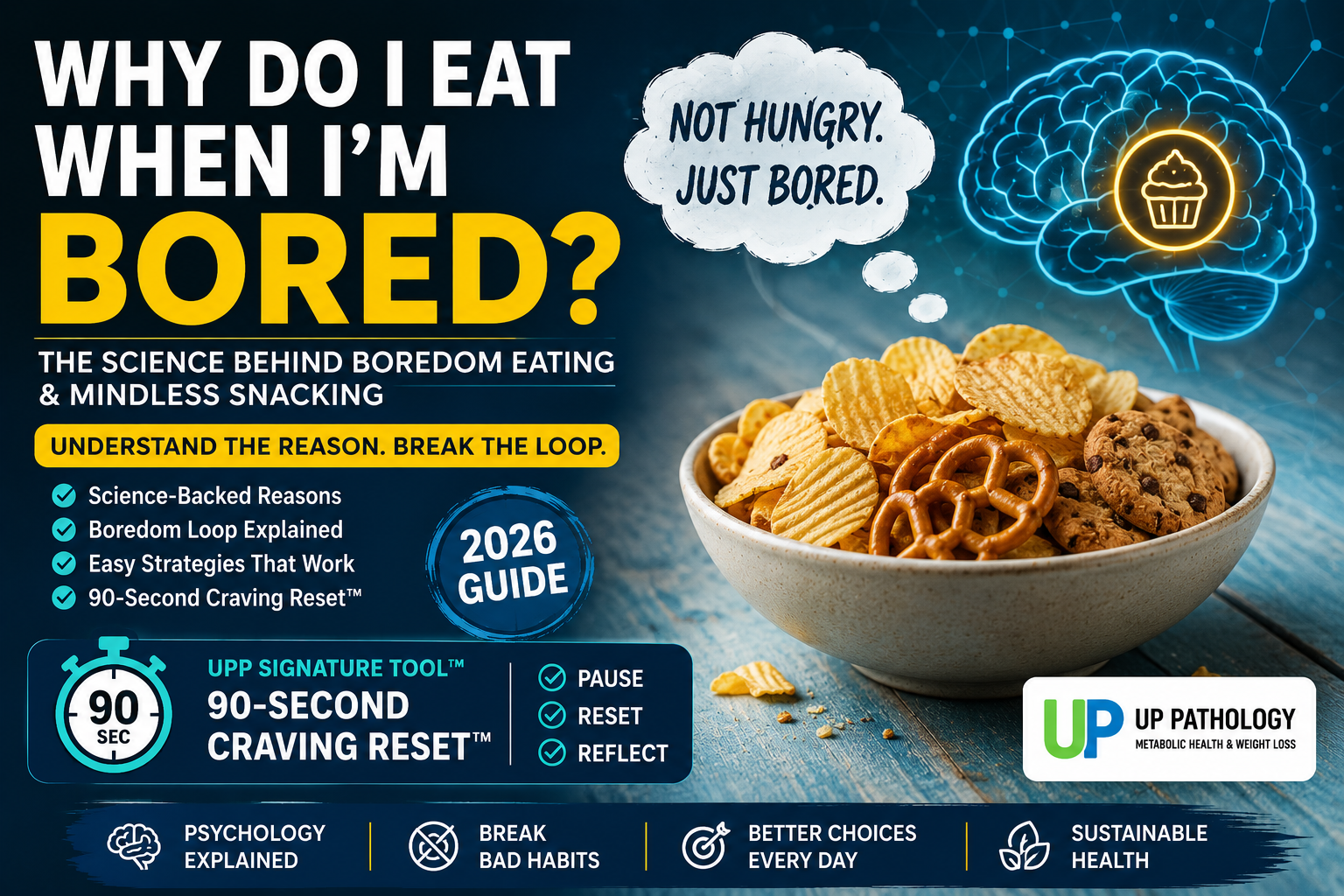
“Why do I eat when I’m bored?”
You’re not alone.
And the answer has very little to do with hunger.
⚡ Quick Answer
Boredom eating happens when your brain looks for stimulation instead of nourishment.
When you’re mentally under-stimulated, your brain naturally searches for something rewarding, enjoyable, or novel. Food—especially sweet, salty, or highly processed foods—can temporarily satisfy that need. This is why many people snack while watching TV, scrolling social media, studying, or working, even when they aren’t physically hungry.
📖 Quick Definition
What Is Boredom Eating?
Boredom eating is the habit of eating in response to mental understimulation rather than true physical hunger. Instead of eating because your body needs energy, you eat because your brain is seeking entertainment, stimulation, or relief from monotony.
📌 In This Guide You’ll Learn
By the end of this article you’ll understand:
✔ Why boredom makes food seem more attractive
✔ The difference between boredom eating and physical hunger
✔ Why your brain looks for snacks when you’re not hungry
✔ How habits strengthen mindless snacking
✔ A practical system to interrupt boredom eating
✔ Science-backed strategies to regain control naturally
🔬 The Science Behind Boredom Eating
Your body needs food for energy.
Your brain needs stimulation.
These are not always the same thing.
When your brain experiences boredom, it interprets the lack of stimulation as something that should be changed.
It starts looking for activities that are:
- Rewarding
- Interesting
- Novel
- Enjoyable
Food easily satisfies all four.
Highly processed foods are especially effective because they combine appealing taste, texture, smell, and instant reward.
This doesn’t necessarily mean you’re hungry.
It means your brain has discovered an easy way to escape boredom.
⭐ UPP Original Framework™
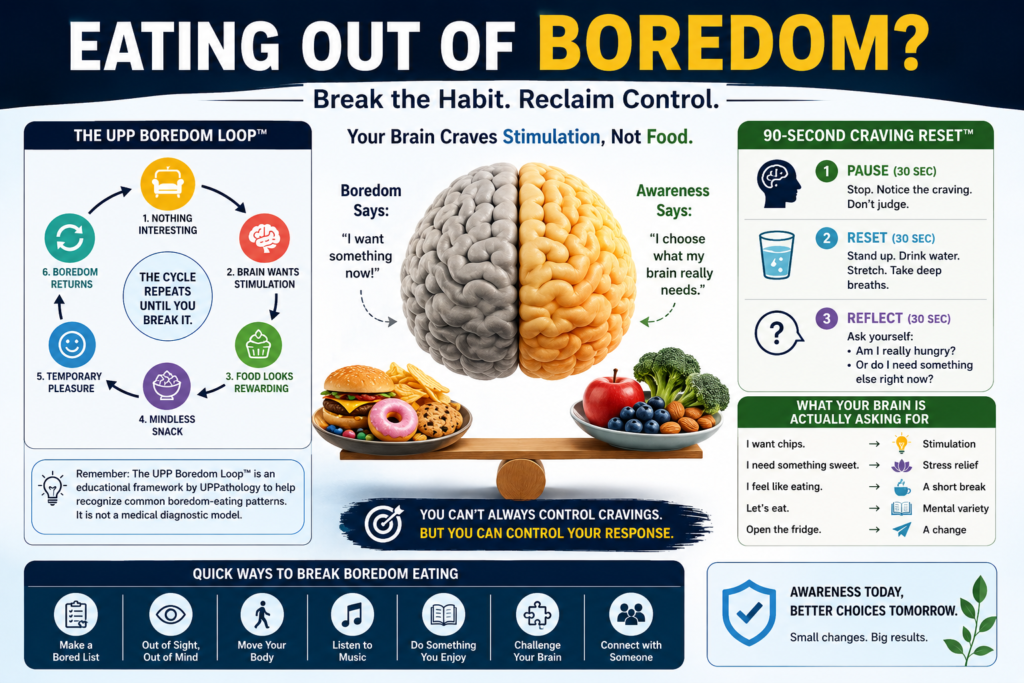
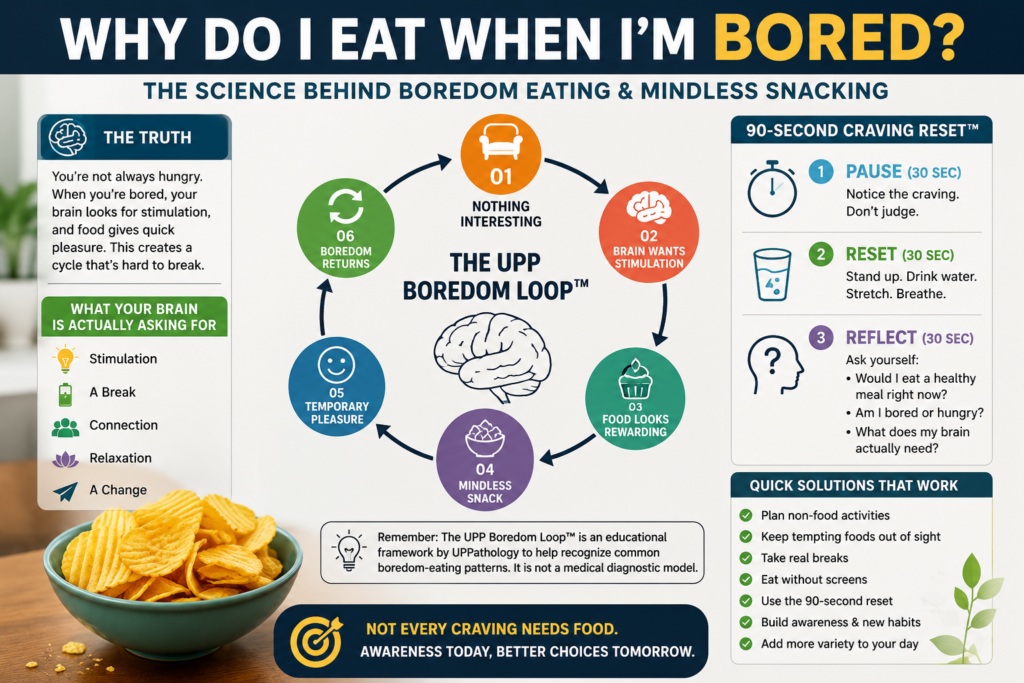
The UPP Boredom Loop™
Nothing Interesting
        ↓
Brain Wants Stimulation
        ↓
Food Looks Rewarding
        ↓
Mindless Snack
        ↓
Temporary Pleasure
        ↓
Boredom Returns
        ↓
Repeat
🧠 Why This Loop Matters
Most people think:
“I’m eating because I’m hungry.”
But the real question is:
“What is my brain trying to escape?”
When you understand the loop, you stop blaming yourself.
Instead, you start changing the trigger.
📍Reason #1 — Your Brain Hates Boredom
From an evolutionary perspective, humans are naturally curious.
When nothing captures your attention, your brain starts searching for something that does.
Food is one of the fastest and easiest sources of stimulation.
That’s why opening the refrigerator often becomes automatic—even when you’re not hungry.
📍Reason #2 — Food Gives Immediate Reward
You don’t have to wait.
You don’t have to think.
One bite provides immediate sensory satisfaction.
Compared with reading a book, exercising, or learning a new skill, eating delivers a reward with almost no effort.
Your brain quickly learns this shortcut.
📍Reason #3 — Habits Replace Decisions
Imagine every evening you:
- Watch television
- Grab chips
- Finish the packet
After repeating this routine enough times, your brain no longer asks:
“Am I hungry?”
Instead, it simply says:
“It’s snack time.”
This is habit-driven eating—not physical hunger.
🧠 Psychology Insight
Your brain often confuses “I need something to do” with “I need something to eat.”
Learning to recognize that difference is one of the most valuable skills for long-term healthy eating.
💡 UPP Expert Tip
The next time you think,
“I need a snack.”
Pause and ask:
“If there were no snacks in my house, what would I do instead?”
Your answer often reveals what your brain actually needs.
📍Reason #4 — You’re Not Hungry, You’re Looking for a Break
Have you ever noticed that you suddenly want a snack after studying for an hour…
Working continuously…
Or finishing a long meeting?
In many cases, your body isn’t asking for calories.
Your brain is asking for a mental break.
Eating temporarily interrupts the task, giving your brain a short period of relief.
Unfortunately, if food becomes your default “break button,” the habit becomes stronger over time.
🧠 UPP Insight
Sometimes the healthiest choice isn’t eating.
It’s simply stepping away from what you’re doing for five minutes.
📍Reason #5 — Highly Palatable Foods Are Hard to Ignore
Not all foods are equally tempting.
Very few people become excited about plain vegetables when they’re bored.
Instead, boredom usually increases the desire for foods that are:
- Sweet
- Salty
- Crunchy
- Creamy
- Highly processed
These foods stimulate multiple senses at once, making them much more rewarding than simple whole foods.
That’s one reason boredom eating often involves chips, cookies, chocolate, or ice cream rather than balanced meals.
📍Reason #6 — Your Environment Encourages Snacking
Look around your room.
Can you easily see:
- Chips?
- Chocolates?
- Biscuits?
- Soft drinks?
Your environment silently influences your decisions.
The easier food is to see and reach…
The more likely you’ll eat it without thinking.
Changing your environment is often easier than trying to strengthen willpower.
📍Reason #7 — Boredom and Loneliness Can Feel Similar
Many people confuse boredom with loneliness.
When you’re alone, food can become a companion.
It creates a brief feeling of comfort and activity.
But once the snack is finished…
The original feeling often returns.
Food can distract you from loneliness for a few minutes.
It rarely solves it.
📍Reason #8 — Mindless Snacking Becomes Automatic
After repeating boredom eating enough times, your brain stops asking for permission.
The sequence becomes automatic.
Bored

↓

Kitchen

↓

Snack

↓

Phone

↓

Repeat
This is why many people don’t even remember deciding to eat.
The habit takes over before conscious thinking begins.
⭐ UPP Signature Tool™
The 90-Second Craving Reset™
The next time boredom makes you think about food…
Don’t immediately open the refrigerator.
Instead, spend just 90 seconds doing this.
Step 1 — Pause (30 Seconds)
Don’t judge yourself.
Simply notice the craving.
Step 2 — Reset (30 Seconds)
Stand up.
Drink a glass of water.
Stretch your body.
Take a few slow breaths.
Step 3 — Reflect (30 Seconds)
Ask yourself three questions.
- Would I eat grilled chicken, dal, or fruit right now?
- Am I looking for food…
or something interesting to do? - What does my brain actually need?
Then decide.
Not automatically.
Consciously.
🧠 What Your Brain Is Actually Asking For
When boredom creates a craving, food isn’t always the answer.
Your brain may actually be asking for:
| Brain Says | What It May Actually Need |
|---|---|
| “I want chips.” | Stimulation |
| “Let’s eat.” | A short break |
| “Something sweet.” | Stress relief |
| “I’m hungry.” | Mental variety |
| “Open the fridge.” | A change of activity |
This simple shift in thinking can completely change your response.
📊 Myth vs Fact
| ❌ Myth | ✅ Fact |
|---|---|
| Eating because you’re bored means you have no self-control. | Boredom eating is a learned behavior influenced by habits and reward systems. |
| Willpower is enough to stop mindless snacking. | Changing routines and your environment is usually more effective than relying only on willpower. |
| Every craving means your body needs food. | Many cravings reflect a need for stimulation, relaxation, or a break—not calories. |
✅ 7 Science-Backed Ways to Stop Boredom Eating
1. Create a “Bored List”
Before cravings appear, make a list of enjoyable non-food activities:
- Read five pages.
- Walk for ten minutes.
- Listen to music.
- Solve a puzzle.
- Call a friend.
When boredom appears, choose one item before choosing food.
2. Keep Tempting Foods Out of Sight
Visible snacks become easy snacks.
Store them out of immediate view whenever possible.
3. Add More Variety to Your Day
Monotony feeds boredom.
Learning a new skill, changing your routine, or trying a different hobby can reduce boredom-driven eating.
4. Take Scheduled Breaks
Instead of eating every time you need a break…
Actually take a break.
Stretch.
Walk.
Look outside.
Your brain often benefits more from movement than from food.
5. Eat Without Screens
Mindless eating increases when attention is focused on television, gaming, or social media.
Practice eating without digital distractions whenever possible.
6. Learn Your Personal Triggers
Notice when boredom eating happens most often.
Morning?
Afternoon?
Late evening?
Patterns reveal opportunities for change.
7. Practice the 90-Second Craving Reset™
Remember:
Not every craving deserves an immediate response.
Sometimes a short pause is enough to help you make a different choice.
🎯 Behavior Change Challenge
The “No Automatic Snacks” Challenge
For the next 7 days…
Every time you feel like eating because you’re bored:
✔ Pause.
✔ Complete the 90-Second Craving Reset™.
✔ Decide consciously whether you still want the food.
Don’t try to be perfect.
Simply become more aware of your patterns.
Awareness is where lasting behavior change begins.
❓ Frequently Asked Questions
Is boredom eating the same as emotional eating?
Not exactly.
Boredom eating is usually driven by a need for stimulation or relief from monotony, while emotional eating is more closely linked to feelings such as stress, sadness, or anxiety. However, the two can sometimes overlap.
Why do I only snack when I’m watching TV?
Television often becomes part of a habit loop. Over time, your brain associates watching TV with eating, even if you’re not physically hungry.
Can boredom eating cause weight gain?
It can contribute if it regularly leads to consuming more energy than your body needs. Long-term eating patterns matter more than occasional snacks.
How do I know if I’m actually hungry?
Ask yourself:
“Would I happily eat a balanced meal right now?”
If the answer is yes, you may be physically hungry. If only highly processed snack foods sound appealing, the craving may have another trigger.
📌 Key Takeaways
✔ Boredom eating is usually driven by a search for stimulation rather than true hunger.
✔ Your environment and daily habits strongly influence mindless snacking.
✔ The UPP Boredom Loop™ helps explain why boredom repeatedly leads to food.
✔ The 90-Second Craving Reset™ gives you time to respond thoughtfully instead of automatically.
✔ Small changes in awareness and routine can make a meaningful difference over time.
📚 Continue Your Learning Journey
Previous Guide
Why Do I Feel Hungry at Night?
Next Guide
How to Stop Emotional Eating Naturally: 10 Science-Backed Strategies That Actually Work
Recommended Reading
- Physical Hunger vs Emotional Hunger vs Psychological Hunger
- Why Can’t I Stop Thinking About Food?
- Why Am I Hungry Right After Eating?
- Why Do I Feel Hungry at Night?
- How to Boost GLP-1 Naturally
- Why Does Every Diet Fail After 2 Weeks?
📚 Trusted Sources
1. Harvard T.H. Chan School of Public Health – Nutrition Source
2. National Institute of Diabetes and Digestive and Kidney Diseases (NIDDK)
3. National Institutes of Health (NIH)
4. American Psychological Association (APA)
5. Centers for Disease Control and Prevention (CDC)
⚠ Medical Disclaimer
This article is intended for educational purposes only and should not replace professional medical advice, diagnosis, or treatment. If eating feels difficult to control, causes significant distress, or is accompanied by symptoms of an eating disorder or another medical condition, seek guidance from a qualified healthcare professional.
🌱 Final Thought
The next time you find yourself standing in front of the refrigerator…
Don’t ask,
“What should I eat?”
Ask,
“What problem am I trying to solve?”
Sometimes the answer is food.
Sometimes it’s rest.
Sometimes it’s connection.
Sometimes it’s simply boredom.
Understanding the difference is one of the most powerful steps toward building healthier eating habits—not through guilt or restriction, but through awareness and intentional choices.