Psychology of Eating Series — Part 2 of 10
Thank you for reading this post, don't forget to subscribe!🧠 Psychology of Eating Series
Season 1 • Part 2 of 10
This article is part of the Psychology of Eating Series, where we explore the science behind hunger, food cravings, emotional eating, appetite hormones, and long-term behavior change.
← Previous: Physical Hunger vs Emotional Hunger vs Psychological Hunger
📚 Series Hub: Psychology of Eating Series
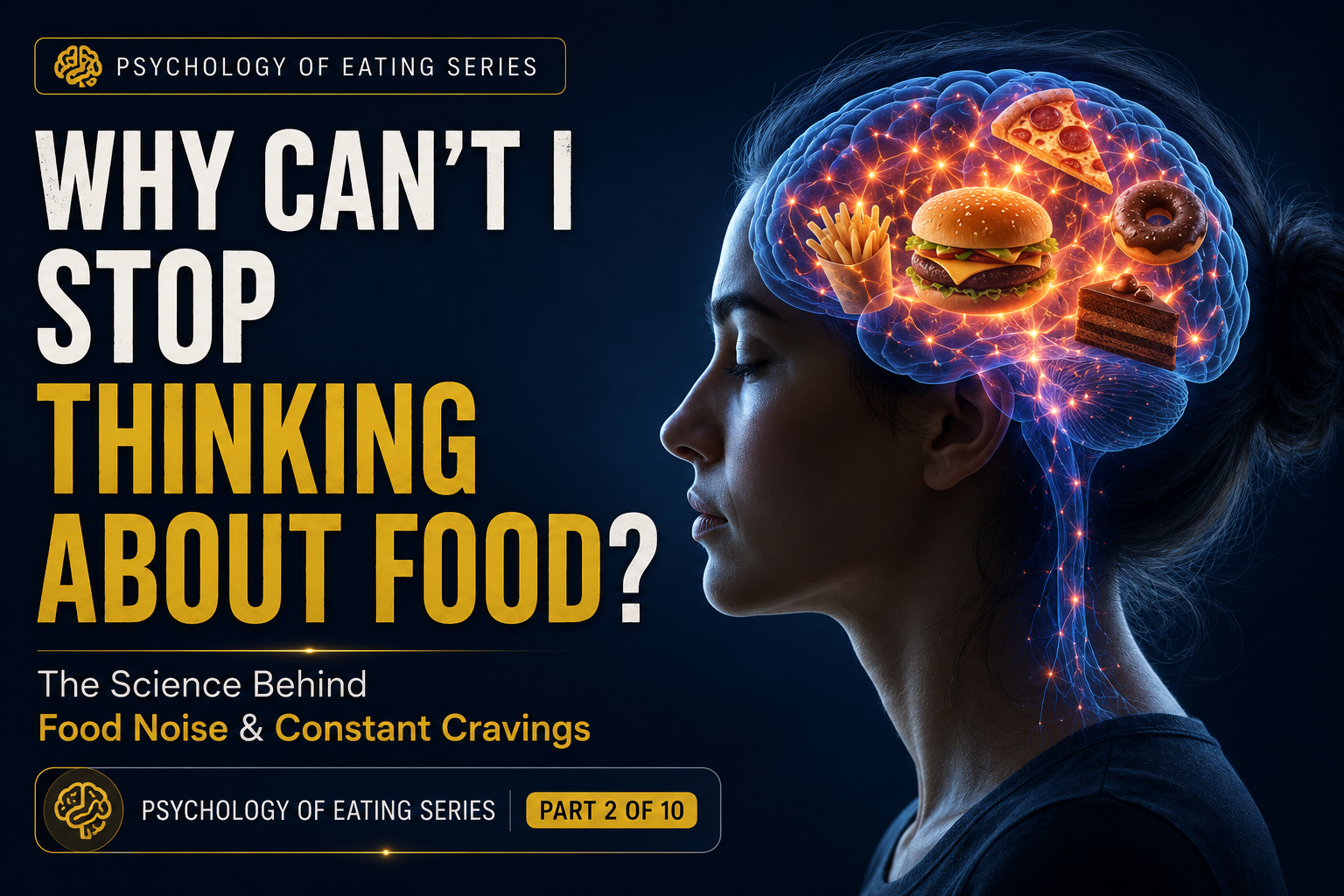
Why Can’t I Stop Thinking About Food?
A Story That May Sound Familiar…
It’s only 10:30 in the morning.
You had a healthy breakfast just two hours ago.
Your stomach doesn’t feel empty.
Yet somehow…
You’re already thinking about lunch.
A few minutes later, you open Instagram and see a cheesy pizza.
Suddenly you’re imagining the smell.
The taste.
The first bite.
You close the app.
Five minutes later, you’re standing in front of the refrigerator.
You aren’t truly hungry.
But food keeps pulling your attention.
By evening, you’ve spent more time thinking about food than actually eating it.
Then comes the guilt.
“Why can’t I stop thinking about food?”
“Do I have no self-control?”
“Is something wrong with me?”
If this sounds familiar, you’re not alone.
Millions of people experience constant thoughts about food—even when their stomach isn’t asking for it.
The surprising truth is that your brain and your environment often play a much bigger role than your stomach.
Understanding why this happens is the first step toward regaining control.
Quick Answer
If you’re asking, “Why can’t I stop thinking about food?”, the answer is usually not because you’re weak or lack willpower.
Your brain constantly processes signals from:
- Hunger hormones
- Blood sugar levels
- Stress
- Sleep quality
- Dopamine (the brain’s reward chemical)
- Food habits
- Emotional triggers
- Highly processed foods
- Your surrounding environment
Together, these factors can create a condition many researchers call food noise—persistent thoughts about food even when your body doesn’t need energy.
The good news?
Food noise can often be reduced by understanding what’s causing it.
🧠 Psychology Trigger
Here’s a simple question.
Imagine someone places your favorite dessert in front of you.
Now ask yourself:
Were you hungry…
or
Did your brain simply become interested in food?
Most people immediately assume those two things are the same.
They’re not.
Your stomach creates physical hunger.
Your brain creates desire.
Learning the difference can completely change the way you think about eating.
Why Your Brain Keeps Thinking About Food
Your brain has one primary job:
Keep you alive.
For thousands of years, food wasn’t always available.
Whenever our ancestors found food, the brain encouraged them to eat because survival depended on it.
Although today’s world has changed dramatically, our brain still follows many of those ancient survival programs.
The only difference?
Instead of occasionally seeing food…
We now see food almost everywhere.
- Television advertisements
- Social media
- Food delivery apps
- Office snacks
- Bakeries
- Coffee shops
- Convenience stores
Your brain constantly receives reminders that food exists.
Every reminder activates memories, emotions, and expectations.
Over time, simply seeing food can become enough to trigger cravings.
What Is Food Noise?
Food noise is a term used to describe persistent, repetitive thoughts about food that seem difficult to control.
It may sound like:
“What should I eat next?”
“Maybe I’ll just have one cookie.”
“I wonder what’s in the fridge.”
“Should I order something?”
These thoughts can appear even after eating a satisfying meal.
Food noise isn’t officially classified as a disease.
Instead, experts use the term to describe the constant mental chatter surrounding food and eating.
For some people, these thoughts are occasional.
For others, they can dominate much of the day.
The Brain Doesn’t Just Respond to Hunger
One of the biggest misconceptions about eating is this:
People eat because they’re hungry.
Science tells a different story.
Your brain makes eating decisions using several different systems at the same time.
These include:
1. Energy System
This system asks:
“Does the body need fuel?”
If yes…
Physical hunger develops.
2. Reward System
This system asks:
“Will this food make me feel good?”
Chocolate.
Pizza.
Ice cream.
Chips.
Highly processed foods strongly activate this system.
Sometimes even thinking about these foods activates reward pathways before you take the first bite.
3. Habit System
Your brain loves routines.
If you usually eat popcorn during movies…
Your brain may expect popcorn every time the movie starts.
Even if you’re completely full.
This isn’t hunger.
It’s learned behavior.
4. Emotional System
Stress.
Loneliness.
Anxiety.
Boredom.
Celebration.
All of these emotions can influence eating.
Food temporarily changes how certain brain chemicals behave.
That’s why many people eat when they’re emotional rather than hungry.
Why Willpower Usually Doesn’t Work
Many people believe:
“I just need more self-control.”
Unfortunately…
That’s rarely enough.
Imagine trying to ignore:
- Hunger hormones
- Dopending dopamine signals
- Emotional stress
- Poor sleep
- Food advertisements
- Years of habits
All at once.
Willpower eventually becomes exhausted.
That’s why lasting behavior change focuses on changing the environment and understanding brain signals—not simply trying harder.
🧠 Psychology Insight
Your brain doesn’t always ask,
“Do you need food?”
Sometimes it asks,
“Would food make you feel better right now?”
Learning to recognize this difference is one of the most powerful skills in long-term appetite control.
What You’ll Learn Next
In the next section, we’ll explore the hidden biology behind food noise, including:
- How GLP-1 helps control appetite
- Why ghrelin makes you feel hungry
- How leptin tells your brain you’re full
- Why dopamine keeps pulling your attention toward food
- The surprising connection between stress, sleep, and constant food thoughts
These mechanisms explain why the question “Why Can’t I Stop Thinking About Food?” often has a biological answer—not just a psychological one.
The Hidden Hormones That Control Your Appetite
If you’ve ever wondered, “Why can’t I stop thinking about food?”, it’s important to understand that your brain doesn’t work alone.
Several hormones constantly communicate with your brain to decide:
- When you should eat
- When you should stop eating
- How rewarding food feels
- Whether you should continue searching for food
Think of your brain as the CEO.
These hormones are the employees constantly sending reports.
If those reports become confusing, your brain may keep thinking about food even when your body already has enough energy.
Let’s meet the four major players.
1. Ghrelin — The Hunger Hormone
Ghrelin is often called the hunger hormone because it tells your brain that it’s time to eat.
It is mainly produced in the stomach.
As your stomach becomes empty, ghrelin levels rise and send a message to the brain:
“Find food now.”
This system helped our ancestors survive when food wasn’t always available.
However, modern lifestyles can increase ghrelin even when your body doesn’t truly need more calories.
Common ghrelin triggers include:
- Skipping meals
- Poor sleep
- Strict dieting
- Rapid weight loss
- Long gaps between meals
When ghrelin stays elevated, food becomes much harder to ignore.
2. Leptin — The Fullness Hormone
If ghrelin tells you to eat…
Leptin tells you to stop.
Leptin is produced by fat cells and sends information to the brain about your body’s stored energy.
When leptin is working properly, your brain understands:
“We’ve had enough food.”
Unfortunately, some people develop leptin resistance.
In this situation, the brain doesn’t respond efficiently to leptin signals.
As a result:
- Hunger increases
- Fullness decreases
- Cravings become stronger
- Weight management becomes more difficult
This is one reason why obesity is much more complex than simply “eating too much.”
3. GLP-1 — Your Natural Appetite Controller
You’ve probably heard about GLP-1 medications.
But your body also produces its own GLP-1 hormone naturally after eating.
GLP-1 helps:
✔ Slow stomach emptying
✔ Increase feelings of fullness
✔ Reduce appetite
✔ Improve blood sugar regulation
✔ Reduce food-seeking behavior
Protein-rich meals, high-fiber foods, and balanced nutrition may help support your body’s natural GLP-1 response.
This is one reason why a high-protein breakfast often keeps people satisfied longer than sugary cereal.
GLP-1 is one of the body’s most important appetite-regulating hormones.
➡️ How to Boost GLP-1 Naturally (Foods, Meal Plan & What to Avoid)
4. Dopamine — The Reward Chemical
Here’s where things become interesting.
Many people assume dopamine creates happiness.
Not exactly.
Dopamine is more closely related to motivation and anticipation.
It encourages you to seek rewards.
That reward could be:
- Food
- Shopping
- Social media
- Gambling
- Video games
When you see your favorite dessert…
Your brain may release dopamine before you even take a bite.
That anticipation makes food feel exciting.
Highly processed foods are especially effective at activating dopamine pathways.
That’s why cravings often feel so powerful.
This is one reason why many restrictive diets become difficult to follow over time.
➡️ Why Does Every Diet Fail After 2 Weeks? 7 Brutal Truths About Weight Loss Psychology
Why Processed Foods Make Food Noise Worse
Imagine eating:
Option A
Grilled chicken
Vegetables
Brown rice
Option B
Large fries
Milkshake
Burger
Dessert
Both provide calories.
But your brain responds very differently.
Highly processed foods are designed to combine:
- Sugar
- Fat
- Salt
- Flavor enhancers
This combination creates a stronger reward response.
Your brain quickly learns:
“That food is worth remembering.”
The result?
You may continue thinking about it long after the meal is over.
Food Noise Cycle
Many people unknowingly become trapped in this cycle.
See Food

↓

Brain Releases Dopamine

↓

Think About Food

↓

Craving Increases

↓

Eat

↓

Temporary Relief

↓

Brain Learns Reward

↓

More Food Thoughts
This cycle can repeat dozens of times throughout the week.
Understanding the cycle is the first step toward breaking it.
Stress Can Make Food Thoughts Worse
Have you ever noticed that stressful days often come with stronger cravings?
That’s not a coincidence.
Stress increases cortisol.
Higher cortisol levels can:
- Increase appetite
- Make sugary foods more attractive
- Reduce self-control
- Increase emotional eating
Your brain isn’t trying to sabotage you.
It’s trying to protect you by searching for quick sources of energy.
Unfortunately, today’s environment offers unlimited access to highly rewarding foods.
Poor Sleep Changes Appetite Signals
Sleeping only five or six hours per night doesn’t just make you tired.
It changes the hormones that regulate hunger.
Research shows poor sleep may:
✔ Increase ghrelin
✔ Decrease leptin
✔ Increase cravings
✔ Reduce impulse control
✔ Increase interest in high-calorie foods
This explains why people often crave sweets after a poor night’s sleep.
Sometimes the solution isn’t another snack.
It’s another hour of sleep.
🧠 Psychology Insight
Your brain doesn’t always reward you for eating.
Sometimes it rewards you simply for thinking about eating.
Every time you imagine your favorite food, your reward system becomes slightly more active.
Over time, repeated thoughts become automatic habits.
Changing those habits begins with awareness—not guilt.
⚡ Brain Fact
Your brain uses only about 2% of your body weight, yet it consumes roughly 20% of your daily energy.
Because the brain depends heavily on a steady energy supply, it has evolved to pay close attention to food-related cues.
In today’s food-rich environment, that survival system can sometimes become overactive.
Physical Hunger vs Food Noise
| Physical Hunger | Food Noise |
|---|---|
| Develops gradually | Appears suddenly |
| Stomach feels empty | Mind feels occupied |
| Any balanced meal sounds good | Specific foods sound irresistible |
| Stops after eating | Thoughts may continue after eating |
| Driven by energy needs | Driven by reward, habits, or emotions |
✅ Quick Self-Test
Ask yourself these five questions before eating.
1. Did I eat within the last 2–3 hours?
□ Yes
□ No
2. Would I happily eat grilled chicken, vegetables, or fruit right now?
□ Yes
□ No
3. Am I thinking about one specific food?
□ Yes
□ No
4. Did stress, boredom, or emotions trigger this craving?
□ Yes
□ No
5. If this food wasn’t available, would I still feel hungry?
□ Yes
□ No
Interpretation
Mostly “Yes” to Questions 2 and 5
➡ Likely Physical Hunger
Mostly “Yes” to Questions 3 and 4
➡ Likely Food Noise or Emotional Eating
Understanding this difference can help you pause before reacting automatically.
How to Stop Thinking About Food: 10 Science-Backed Strategies
Now comes the most important question.
After learning the science behind food noise, you might wonder:
“What can I actually do to stop thinking about food?”
The goal isn’t to eliminate every thought about food.
That’s impossible.
The goal is to reduce unnecessary food thoughts so your brain can focus on living—not constantly planning the next meal.
Here are ten evidence-based strategies that actually work.
1. Never Skip Protein at Breakfast
A breakfast rich in protein can improve fullness and reduce cravings later in the day.
Good options include:
- Eggs
- Greek yogurt
- Cottage cheese
- Tofu
- Protein smoothie
- Lentils
Protein supports satiety hormones like GLP-1 and helps reduce frequent hunger signals.
Choosing protein-rich meals may help support natural appetite control and reduce unnecessary hunger.
➡️ Best GLP-1 Diet Plan for Beginners (7-Day Hunger Control Meal Plan)
2. Eat More Fiber
Fiber slows digestion.
As a result:
✔ You stay full longer.
✔ Blood sugar becomes more stable.
✔ Cravings decrease.
Excellent fiber sources include:
- Oats
- Beans
- Apples
- Pears
- Chia seeds
- Vegetables
- Whole grains
3. Improve Your Sleep
One extra hour of quality sleep can sometimes reduce cravings more effectively than another cup of coffee.
Aim for:
- 7–9 hours
- Consistent bedtime
- Limited screen exposure before sleep
Your appetite hormones will thank you.
4. Remove Constant Food Cues
Your brain notices everything.
Instead of relying only on willpower:
- Keep snacks out of sight.
- Don’t leave sweets on the kitchen counter.
- Unfollow food accounts that trigger cravings.
- Avoid unnecessary browsing of food delivery apps.
Changing your environment is often easier than fighting your brain.
5. Learn the 30-Second Pause Method
Before eating, stop for 30 seconds and ask yourself:
✔ Am I physically hungry?
✔ Would I eat a balanced meal right now?
✔ Am I stressed?
✔ Am I bored?
✔ Is this just food noise?
This simple pause interrupts automatic eating behavior.
6. Manage Stress Before It Manages You
Instead of eating immediately, try:
- Walking for five minutes
- Deep breathing
- Stretching
- Calling a friend
- Journaling
- Listening to calming music
Sometimes your brain needs comfort—not calories.
7. Stay Hydrated
Mild dehydration sometimes feels similar to hunger.
Before grabbing a snack:
Drink a glass of water.
Wait ten minutes.
You may discover you weren’t hungry after all.
8. Build Structured Meal Times
Constant grazing keeps your brain focused on food.
Instead:
Create predictable meal times.
Your brain gradually learns:
“Food is coming.”
That certainty often reduces food-related anxiety.
9. Practice Mindful Eating
Slow down.
Notice:
- Taste
- Texture
- Aroma
- Fullness
Eating while scrolling social media makes it easier to miss your body’s natural fullness signals.
10. Stop Feeling Guilty About Food Thoughts
This may be the most important strategy of all.
Food thoughts do not mean you’re weak.
They do not mean you’ve failed.
Your brain is responding to biology, habits, emotions, and your environment.
Understanding those signals gives you the power to respond differently.
🧠 The 30-Second Hunger Check
Before eating, ask yourself:
✅ When did I last eat?
✅ Is my stomach actually empty?
✅ Would I happily eat a healthy meal?
✅ Am I stressed, bored, lonely, or anxious?
✅ Did something trigger this craving?
If most of your answers point toward emotions or triggers rather than true hunger, consider taking a short break before deciding to eat.
🎯 Today’s Behavior Challenge
For the next 24 hours, keep a simple note on your phone.
Every time you think about food, write down:
- Time
- Hunger level (1–10)
- Emotion
- Situation
- What you wanted to eat
At the end of the day, review your notes.
You may discover patterns you never noticed before.
Awareness is the first step toward lasting behavior change.
Key Takeaways
- Food thoughts are not always caused by physical hunger.
- Hormones such as ghrelin, leptin, and GLP-1 influence appetite.
- Dopamine can make food feel rewarding even before you eat.
- Stress, poor sleep, habits, and food cues all contribute to food noise.
- Small daily habits can gradually reduce unnecessary thoughts about food.
Remember:
Your stomach may ask for food. Your brain may ask for comfort. Learning the difference can change the way you eat for life.
Frequently Asked Questions (FAQs)
Why can’t I stop thinking about food even after eating?
Persistent food thoughts after a meal are often linked to food noise, reward pathways, stress, habits, sleep deprivation, or highly processed foods rather than true physical hunger.
Is food noise a medical condition?
Food noise is not an official medical diagnosis. It is a commonly used term that describes frequent, repetitive thoughts about food that can affect daily life.
Can stress increase food cravings?
Yes. Stress increases cortisol levels, which may raise appetite and make highly rewarding foods more appealing.
Does poor sleep make food cravings worse?
Yes. Poor sleep can increase ghrelin, reduce leptin, and make it harder to resist cravings.
Can GLP-1 help reduce food noise?
GLP-1 helps increase fullness and reduce appetite. Supporting your body’s natural GLP-1 response through balanced meals may help some people experience fewer food-related thoughts.
Continue the Psychology of Eating Series
✅ Previous Guide
📖 Current Guide
Why Can’t I Stop Thinking About Food? The Science Behind Food Noise & Constant Cravings
▶ Next Guide
Why Am I Hungry Right After Eating? 9 Hidden Reasons You Never Feel Full
Trusted Sources
For additional evidence-based information:
- National Center for Biotechnology Information (NCBI)
https://www.ncbi.nlm.nih.gov/ - MedlinePlus (U.S. National Library of Medicine)
https://medlineplus.gov/ - Office of Dietary Supplements (NIH ODS)
https://ods.od.nih.gov/ - Academy of Nutrition and Dietetics
https://www.eatright.org/ - The Obesity Society
https://www.obesity.org/
Final Thoughts
If you’ve been asking yourself, “Why Can’t I Stop Thinking About Food?”, remember that the answer is rarely about a lack of willpower. Your thoughts about food are shaped by biology, psychology, habits, hormones, and the environment around you.
The good news is that these patterns can change.
By understanding how your brain and body work together, you can reduce food noise, respond to hunger more intentionally, and build healthier eating habits that last.