Why am I hungry right after eating? Discover 9 science-backed reasons you never feel full and learn practical strategies to stay satisfied longer without restrictive dieting.
Thank you for reading this post, don't forget to subscribe!🧠 Psychology of Eating Series
Part 3 of 10
Understand the science behind hunger, satiety, appetite hormones, and eating behavior.
← Previous Guide | 📚 View Full Series | Next Guide →
You Just Ate… So Why Are You Hungry Again?
You finish your lunch.
A balanced meal.
Rice, vegetables, dal, and yogurt.
You lean back in your chair thinking,
“That was enough.”
But just twenty minutes later, you walk into the kitchen.
You open the refrigerator.
You aren’t looking for another meal.
Maybe just something sweet.
Maybe a handful of chips.
Maybe “just one biscuit.”
You pause for a moment and ask yourself,
“How can I already be hungry? I literally just ate.”
If you’ve experienced this, you’re not alone.
Many people believe that hunger is controlled only by an empty stomach. In reality, hunger is much more complex. Your brain, digestive system, eating habits, food choices, and even the speed at which you eat all influence whether you feel satisfied after a meal.
The good news is that feeling hungry soon after eating doesn’t always mean you need more food. Often, it’s your body giving you important signals that are worth understanding.
⚡ Quick Answer
If you’re asking, “Why am I hungry right after eating?”, the answer usually isn’t that your body suddenly needs more calories.
In many cases, the reason is a combination of poor satiety, fast eating, low protein intake, low fiber intake, blood sugar fluctuations, or eating habits that prevent your brain from recognizing fullness. Understanding these factors can help you stay full longer without relying on willpower alone.
📌 In This Guide You’ll Learn
By the end of this guide, you’ll understand:
- Why you can feel hungry even after eating a full meal.
- The difference between hunger and poor satiety.
- The most common science-backed reasons you never feel full.
- Simple habits that improve fullness naturally.
- How to recognize whether your body actually needs more food.
🔬 The Science of Feeling Full
Many people think fullness begins in the stomach.
Actually, fullness begins in the brain.
Your stomach, intestines, and brain constantly communicate with each other. As food moves through your digestive system, your body starts collecting information.
Instead of simply asking,
“Did you eat?”
your brain asks several questions at once.
- How much food entered the stomach?
- Was the meal rich in protein?
- Did it contain enough fiber?
- Is blood sugar stable?
- Has enough time passed for fullness signals to arrive?
Only after processing these signals does your brain decide whether you feel satisfied.
This explains why two meals containing the same number of calories can leave you feeling completely different.
A meal built around whole foods often keeps you satisfied for hours, while a highly processed meal may leave you searching for another snack shortly afterward.
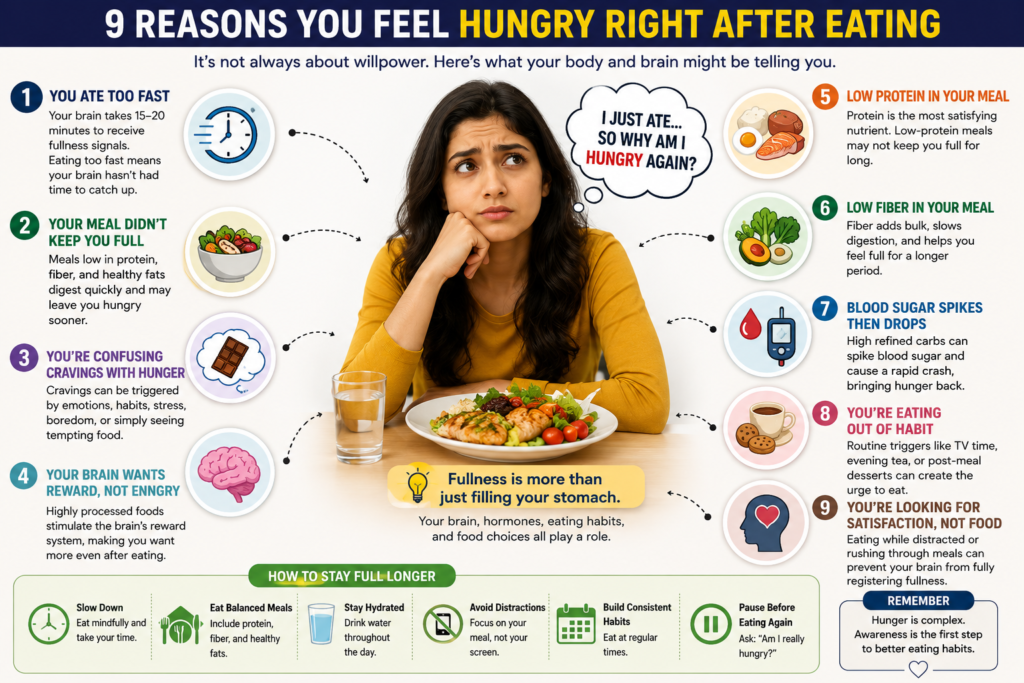
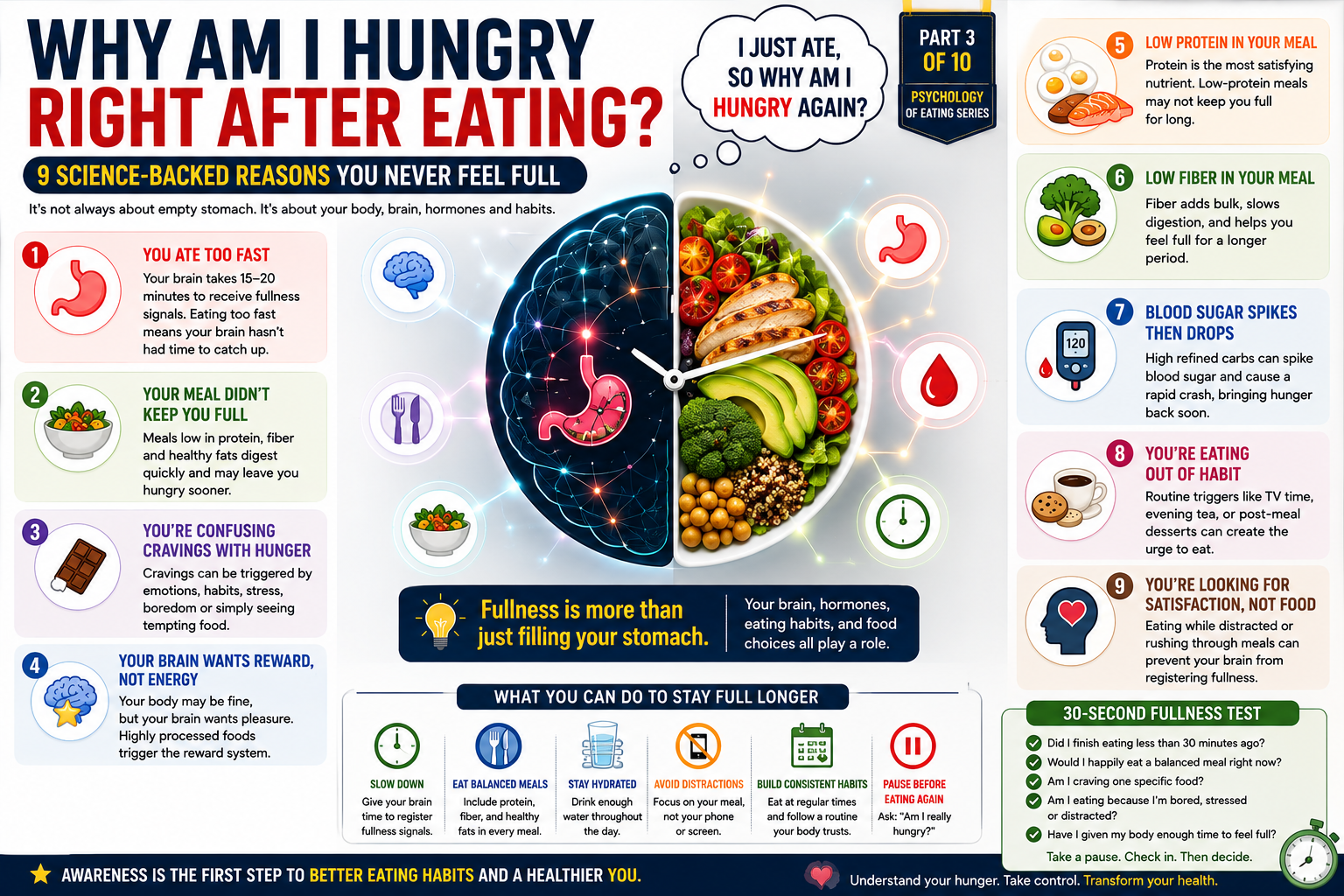
Reason #1 — You Ate Too Fast
One of the most common reasons people feel hungry right after eating has nothing to do with the amount of food they consumed.
It has to do with speed.
Your brain doesn’t recognize fullness instantly.
It takes time for your digestive system to send “I’m full” signals.
If you finish an entire meal in five or six minutes, your stomach may already contain enough food, but your brain hasn’t processed that information yet.
As a result, you may still feel like eating more.
💡 Psychology Insight
Fast eating often becomes an automatic habit rather than a conscious choice.
Slowing down isn’t just good table manners—it gives your brain enough time to catch up with your stomach.
Reason #2 — Your Meal Didn’t Keep You Full
Not every meal provides the same level of satiety.
For example:
- A sugary breakfast may satisfy you for a short time.
- A balanced breakfast containing protein, fiber, and healthy fats usually keeps you full much longer.
The quality of your meal matters just as much as the quantity.
Meals that digest very quickly can leave you feeling hungry again sooner than expected.
Reason #3 — You’re Confusing Cravings with Hunger
One of the biggest mistakes people make is assuming that every desire to eat means they’re physically hungry.
That’s not always true.
Sometimes what feels like hunger is actually:
- a craving,
- a habit,
- boredom,
- stress,
- or simply seeing tempting food.
This is why learning the difference between physical hunger, emotional hunger, and psychological hunger is so important.
Understanding these differences helps you respond more intentionally instead of automatically reaching for food.
Reason #4 — Your Brain Wants Reward, Not Energy
Your body may have enough energy.
But your brain may still be searching for a reward.
Highly processed foods are designed to be extremely enjoyable.
Even after a meal, simply seeing desserts, snacks, or advertisements can trigger thoughts about eating again.
This doesn’t necessarily mean you’re hungry.
It means your brain has learned to associate certain foods with pleasure, comfort, or routine.
The next section explores five more hidden reasons you may never feel fully satisfied, along with practical strategies to improve satiety without restrictive dieting.
Reason #5 — Your Meal Was Low in Protein
Have you ever eaten two bowls of cereal and still felt hungry…
But after eating eggs or Greek yogurt, you stayed full for hours?
That’s because protein is one of the most satisfying nutrients you can eat.
Protein slows digestion and helps your body feel satisfied after a meal.
Meals that contain very little protein may leave you looking for another snack much sooner.
Foods Naturally Rich in Protein
- Eggs
- Greek yogurt
- Chicken
- Fish
- Lentils
- Cottage cheese
- Tofu
- Beans
You don’t need a high-protein diet.
You simply need enough protein in each meal to support better satiety.
Reason #6 — Your Meal Was Low in Fiber
Imagine eating:
🥐 A croissant
or
🥗 A large salad with beans and vegetables.
Both may contain similar calories.
But they won’t make you feel full for the same amount of time.
Fiber absorbs water, adds bulk to your meal, and slows digestion.
As food moves more slowly through your digestive system, fullness tends to last longer.
Many people who constantly feel hungry simply aren’t eating enough fiber throughout the day.
Foods High in Fiber
✔ Oats
✔ Apples
✔ Pears
✔ Beans
✔ Lentils
✔ Chia Seeds
✔ Vegetables
✔ Whole grains
Small improvements in daily fiber intake often have a much bigger impact than people expect.
Reason #7 — Blood Sugar Rose… Then Dropped Quickly
Have you ever noticed this pattern?
You eat something sweet.
You feel energetic.
Thirty to sixty minutes later…
You suddenly want more food.
This often happens because meals high in refined carbohydrates can cause rapid changes in blood sugar levels.
When blood sugar rises and then falls quickly, your body may respond with renewed hunger—even though you’ve recently eaten.
That’s one reason balanced meals containing protein, fiber, and healthy fats often keep people satisfied longer than meals made mostly of refined carbohydrates.
Reason #8 — You’re Eating Out of Habit
Sometimes your body isn’t asking for food.
Your routine is.
For example:
- Dessert after dinner
- Chips while watching TV
- Tea with biscuits every evening
- Popcorn during movies
After repeating these behaviors many times, your brain begins to expect them.
Eventually, the situation itself becomes the trigger.
You sit down to watch a movie…
And suddenly you “feel hungry.”
In reality, your brain is responding to a habit—not an energy need.
🧠 Psychology Insight
Habits don’t ask permission.
They run automatically until you notice them.
The first step isn’t trying to stop the habit.
The first step is recognizing when it begins.
Reason #9 — You’re Looking for Satisfaction, Not Food
This may be the most overlooked reason of all.
Sometimes people don’t continue eating because they’re hungry.
They continue eating because the meal didn’t feel satisfying.
Maybe you ate too quickly.
Maybe you ate while answering emails.
Maybe you were distracted by your phone.
Your stomach received food…
But your brain never fully experienced the meal.
When eating becomes automatic, it’s easier to miss your body’s natural fullness signals.
That’s why slowing down and paying attention can make a surprisingly big difference.
✅ 7 Ways to Stay Full Longer
Instead of focusing on eating less, focus on eating smarter.
1. Slow Down
Take at least 20 minutes to finish your meal whenever possible.
2. Include Protein in Every Meal
Protein helps improve satiety and supports muscle health.
3. Eat More Fiber
Aim to include vegetables, fruit, legumes, or whole grains regularly.
4. Minimize Distractions
Try not to eat while scrolling social media or watching television.
Your brain notices meals more effectively when you’re present.
5. Drink Enough Water
Sometimes mild dehydration feels similar to hunger.
Start with a glass of water before assuming you need another snack.
6. Build Consistent Meal Habits
Eating at roughly similar times each day can help your body develop predictable hunger patterns.
7. Pause Before Eating Again
Instead of immediately reaching for more food, give yourself a few minutes to ask:
“Am I still physically hungry… or am I simply looking for something to eat?”
That single question often changes the decision.
📋 The 30-Second Fullness Test
Before reaching for another snack, ask yourself these five questions:
✔ Did I finish eating less than 30 minutes ago?
✔ Would I happily eat a balanced meal right now?
✔ Am I craving one specific food?
✔ Am I eating because I’m bored, stressed, or distracted?
✔ Have I given my body enough time to feel full?
Your Results
Mostly YES to Questions 1, 3, or 4
👉 You may be experiencing a craving or habit rather than true hunger.
Mostly YES to Questions 2 and 5
👉 Your body may genuinely need more nourishment, or your previous meal may not have been satisfying enough.
Remember, this checklist is a self-awareness tool—not a medical diagnosis.
📊 Quick Comparison
| You May Be Truly Hungry If… | It May Be a Craving If… |
|---|---|
| Hunger develops gradually | Hunger appears suddenly |
| Almost any balanced meal sounds appealing | Only one specific food sounds good |
| Your stomach feels empty | Your stomach feels comfortable, but your mind wants food |
| Hunger improves after eating | The desire to eat continues even after a meal |
Frequently Asked Questions (FAQs)
Why am I hungry right after eating even though I had a full meal?
Feeling hungry soon after eating doesn’t always mean your body needs more calories. Fast eating, low-protein meals, low-fiber intake, blood sugar fluctuations, eating habits, or simply not giving your brain enough time to recognize fullness can all contribute to this feeling.
How long should I stay full after a meal?
For most healthy adults, a balanced meal should help you feel satisfied for 3–5 hours. However, this can vary depending on meal composition, activity level, sleep, stress, and individual metabolism.
Can dehydration make me feel hungry?
Yes. Mild dehydration can sometimes be mistaken for hunger because the brain processes thirst and hunger through similar pathways. Drinking a glass of water before reaching for a snack may help you determine whether you’re actually hungry.
Why do I crave sweets immediately after lunch or dinner?
Sweet cravings after meals are often influenced by habit, food preferences, and the brain’s reward system rather than genuine physical hunger. If this happens regularly, consider whether it’s a routine you’ve developed over time rather than a biological need.
Should I eat again if I still feel hungry?
rst, pause for a few minutes and ask yourself:
Did I eat enough protein?
Was my meal balanced?
Did I eat too quickly?
Am I actually hungry, or am I simply craving something?
If you’re still genuinely hungry after reflecting on these questions, choosing a balanced, nutrient-rich snack may be more helpful than reaching for highly processed foods.
📌 Key Takeaways
Before you leave, remember these five important points:
✔ Feeling hungry after eating doesn’t always mean your body needs more food.
✔ Eating too quickly can prevent your brain from recognizing fullness.
✔ Meals that include protein and fiber generally keep you satisfied longer.
✔ Habits, distractions, and cravings can feel very similar to real hunger.
✔ Small daily changes often improve appetite control more effectively than restrictive dieting.
💡 Psychology Insight
Most people spend years trying to control how much they eat.
Very few spend time understanding why they want to eat.
The moment you begin asking,
“What is causing this feeling?”
instead of
“How do I stop it?”
your relationship with food begins to change.
Awareness is often the first step toward healthier eating habits.
📚 Continue Your Learning Journey
This guide is one part of the Psychology of Eating Series, designed to help you understand hunger, cravings, metabolism, and long-term behavior change.
Continue Reading
← Part 2
Why Can’t I Stop Thinking About Food? The Science Behind Food Noise & Constant Cravings
📖 Recommended Reading
If you found this guide helpful, you may also enjoy:
- Physical Hunger vs Emotional Hunger vs Psychological Hunger: 9 Signs You’re Eating for the Wrong Reason
- How to Boost GLP-1 Naturally (Foods, Meal Plan & What to Avoid)
- Best GLP-1 Diet Plan for Beginners (7-Day Hunger Control Meal Plan)
- Why Do I Crave Sugar When I’m Stressed?
- Why Does Every Diet Fail After 2 Weeks?
📚 Trusted Sources
For additional evidence-based information:
- Harvard Nutrition Source – Healthy Eating Plate
https://www.hsph.harvard.edu/nutritionsource/healthy-eating-plate/ - NIDDK – Healthy Eating & Nutrition
https://www.niddk.nih.gov/health-information/weight-management - NIH MedlinePlus – Hunger & Nutrition Topics
https://medlineplus.gov/nutrition.html - CDC – Healthy Weight & Nutrition
https://www.cdc.gov/healthy-weight-growth/ - APA – Stress Effects on the Body
https://www.apa.org/topics/stress/body
Medical Disclaimer
This article is intended for educational purposes only and should not be considered medical advice, diagnosis, or treatment. If you experience persistent hunger, unexplained weight changes, or symptoms that concern you, consult a qualified healthcare professional.
Final Thoughts
The next time you catch yourself wondering,
“Why am I hungry right after eating?”
don’t immediately assume you need another meal.
Pause.
Take a breath.
Think about how you ate, what you ate, and why you still feel like eating.
Sometimes your body is asking for nourishment.
Sometimes your brain is responding to habit.
Learning the difference is one of the most valuable skills you can develop for long-term health.
Healthy eating isn’t about fighting your body.
It’s about understanding the signals it’s trying to send.