Author: Drx. Prashant Kumar
Thank you for reading this post, don't forget to subscribe!Category: Metabolic Health & Weight Loss
Updated: 2026
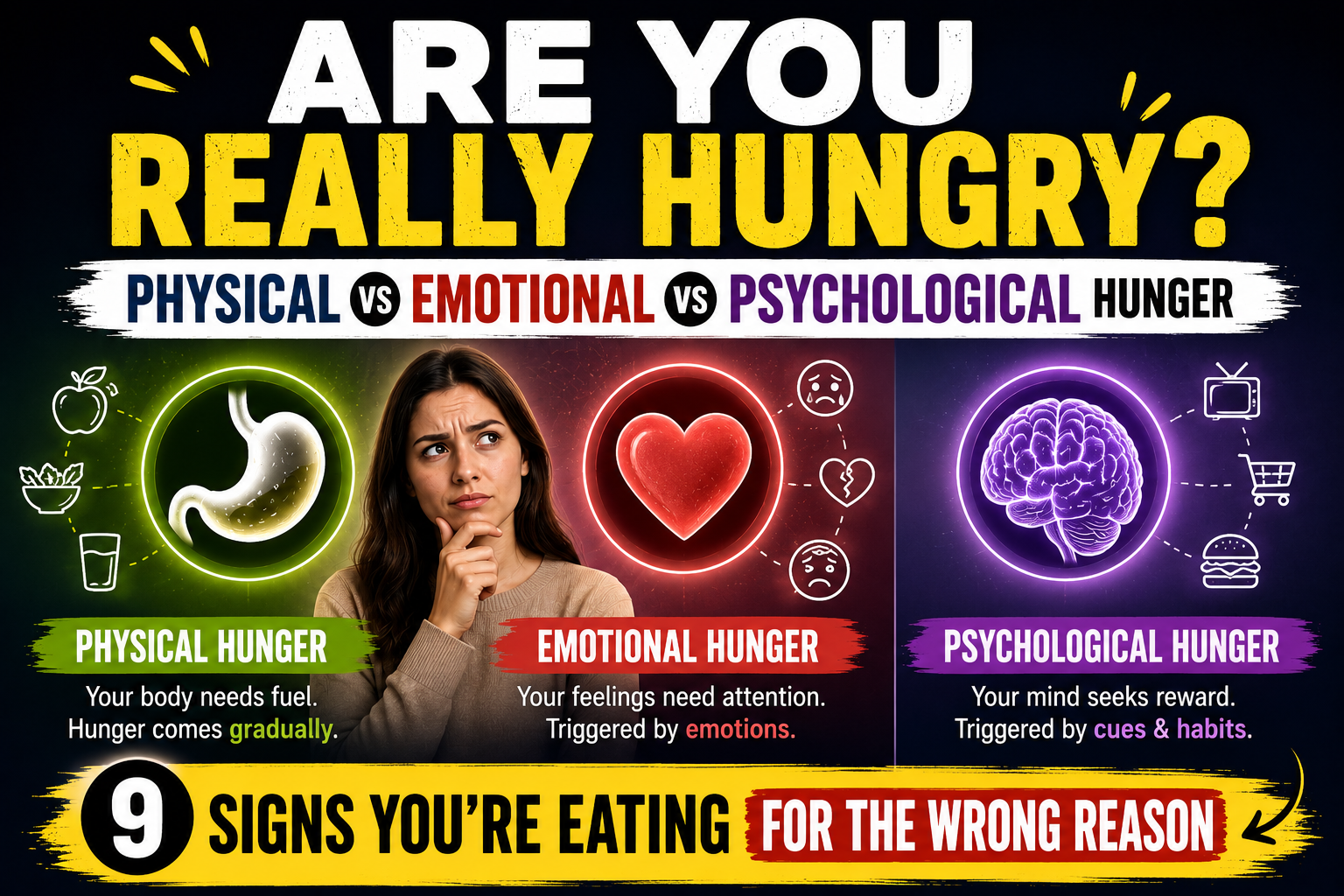
Physical hunger vs emotional hunger vs psychological hunger explained with 9 science-backed signs to help you identify real hunger, stop cravings, and make smarter eating decisions.
Quick Answer
Have you ever finished a meal and then felt hungry again just 30 minutes later?
If yes, your body may not actually need food.
Understanding physical hunger vs emotional hunger vs psychological hunger can completely change the way you eat, manage cravings, and lose weight. Physical hunger is driven by biological needs, emotional hunger is triggered by feelings, and psychological hunger is often influenced by habits, food cues, and the brain’s reward system.
Learning the difference can help you stop overeating, reduce cravings, and make healthier food choices.
Why Am I Hungry Even After Eating?
This is one of the most common questions people ask when trying to lose weight.
You eat a meal.
Your stomach feels full.
Yet an hour later, you suddenly want:
- Ice cream
- Chips
- Chocolate
- Pizza
- Cookies
Most people assume this means they are still hungry.
But that’s not always true.
The reality is that not all hunger is the same.
Many people spend years confusing physical hunger vs emotional hunger vs psychological hunger, which leads to unnecessary eating, weight gain, and frustration.
The Hidden Problem Most People Never Learn
Schools teach us about nutrition.
Doctors talk about calories.
Fitness influencers discuss meal plans.
But very few people explain the difference between the three major types of hunger.
As a result, people often eat when:
- They are stressed
- They are bored
- They are anxious
- They see food advertisements
- They smell fresh food
- They feel lonely
None of these situations necessarily mean the body requires energy.
Understanding physical hunger vs emotional hunger vs psychological hunger is often the missing piece for people who struggle with cravings.
What Is Physical Hunger?
Physical hunger is your body’s natural signal that it needs fuel.
This type of hunger develops gradually.
It is controlled by hormones, blood sugar levels, digestion, and energy requirements.
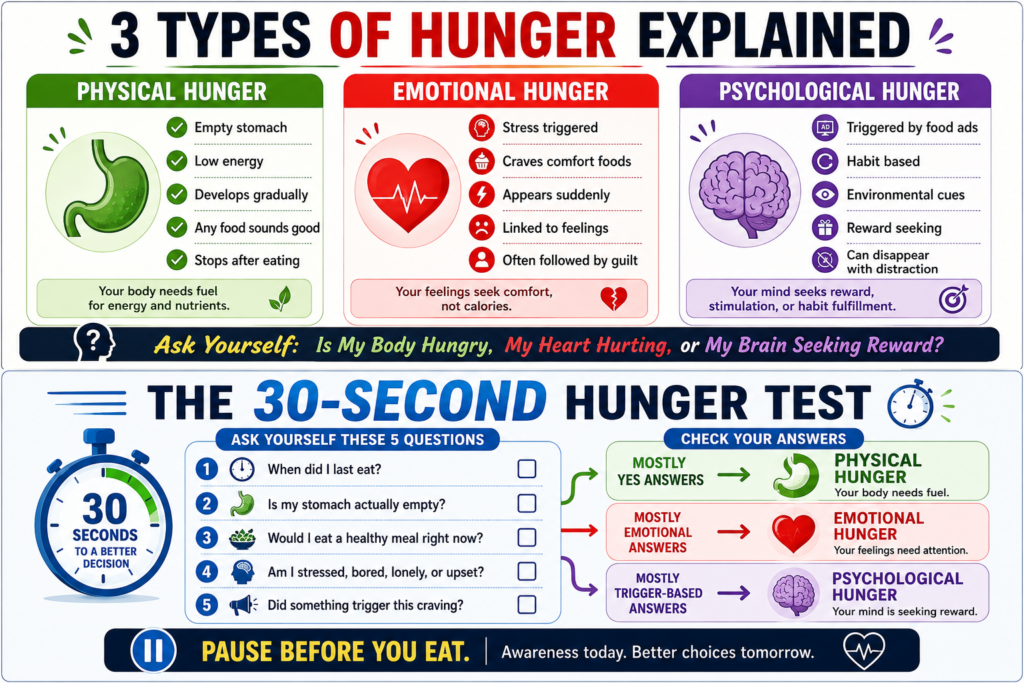
Common Signs of Physical Hunger
✔ Stomach growling
✔ Low energy
✔ Mild irritability
✔ Difficulty concentrating
✔ Hunger increases slowly over time
✔ Almost any food sounds appealing
Physical hunger is a biological survival mechanism.
Your body is asking for nutrients and energy.
Example of Physical Hunger
Imagine you skipped lunch.
By late afternoon:
- Your stomach growls.
- Energy drops.
- You begin thinking about food.
At this point, a healthy meal, a sandwich, fruit, or even simple home-cooked food sounds good.
That is genuine physical hunger.
What Is Emotional Hunger?
Emotional hunger has nothing to do with nutritional needs.
Instead, it is driven by emotions.
Common triggers include:
- Stress
- Anxiety
- Loneliness
- Anger
- Frustration
- Sadness
- Relationship problems
Food becomes a coping mechanism rather than a fuel source.
This is why many people crave comfort foods during difficult times.
Common Signs of Emotional Hunger
✔ Appears suddenly
✔ Triggered by feelings
✔ Craves specific comfort foods
✔ Often continues after fullness
✔ Followed by guilt
✔ Frequently linked to stressful situations
Example of Emotional Hunger
You have a difficult day at work.
Your boss criticizes a project.
You feel frustrated.
On the drive home, you suddenly want ice cream.
Your stomach isn’t empty.
Your body doesn’t need energy.
You’re trying to soothe emotions.
This is emotional hunger.
What Is Psychological Hunger?
Psychological hunger is different from emotional hunger.
It is triggered by the brain rather than the stomach.
Unlike emotional hunger, it may occur even when you’re feeling perfectly fine.
Psychological hunger is often activated by:
- Food advertisements
- Social media
- Smells
- Habits
- Visual food cues
- Learned routines
This is where many people become confused when comparing physical hunger vs emotional hunger vs psychological hunger.
Psychological hunger can feel very real even though the body has enough energy.
Common Signs of Psychological Hunger
✔ Triggered by seeing food
✔ Triggered by habit
✔ Associated with cravings
✔ Often appears at predictable times
✔ Not linked to physical stomach sensations
✔ Can disappear quickly when distracted
Example of Psychological Hunger
You walk through a shopping mall.
You smell fresh cinnamon rolls.
Suddenly you want one.
Ten minutes earlier you weren’t hungry.
Your stomach wasn’t asking for food.
The environment triggered a craving.
This is psychological hunger.
Why Understanding the Difference Matters
Most people treat all hunger the same.
This creates a major problem.
If emotional hunger is mistaken for physical hunger:
→ overeating occurs.
If psychological hunger is mistaken for physical hunger:
→ unnecessary snacking occurs.
If physical hunger is ignored:
→ cravings often become stronger later.
Understanding physical hunger vs emotional hunger vs psychological hunger helps you respond appropriately instead of automatically reaching for food.
Sign #1: How Fast Does the Hunger Appear?
Physical hunger develops gradually.
You usually notice it increasing over several hours.
Emotional hunger often appears suddenly.
Psychological hunger can appear instantly after a trigger.
Example
Physical Hunger:
“I haven’t eaten since breakfast.”
Emotional Hunger:
“I had an argument and now I need chocolate.”
Psychological Hunger:
“I saw a pizza commercial and suddenly want pizza.”
This timing difference is one of the easiest ways to identify the type of hunger you’re experiencing.
Sign #2: Are You Craving One Specific Food?
Physical hunger is flexible.
Many foods sound acceptable.
Emotional hunger usually wants comfort foods.
Psychological hunger often wants highly rewarding foods that are connected to habits or memories.
Ask Yourself
Would I eat:
- Chicken?
- Fruit?
- Vegetables?
- Rice?
If the answer is yes, you’re probably physically hungry.
If the answer is:
“I only want chocolate.”
The hunger is more likely emotional or psychological.
Sign #3: Does Hunger Go Away After Eating?
One of the biggest differences in physical hunger vs emotional hunger vs psychological hunger is what happens after you eat.
Physical Hunger
When the body gets enough food:
✔ Hunger decreases
✔ Satisfaction increases
✔ Eating stops naturally
Emotional Hunger
Even after eating:
❌ Satisfaction may not occur
❌ Cravings may continue
❌ More food may be consumed
Psychological Hunger
Sometimes a craving disappears after a few bites.
Other times, the habit continues even when fullness appears.
Example
A physically hungry person eats dinner and feels satisfied.
An emotionally hungry person may finish dinner and immediately look for dessert.
Sign #4: What Triggered the Hunger?
Every type of hunger has different triggers.
Physical Hunger Triggers
- Long time without food
- Exercise
- Low energy
- Increased calorie needs
Emotional Hunger Triggers
- Stress
- Anxiety
- Loneliness
- Frustration
- Sadness
Psychological Hunger Triggers
- Watching TV
- Food advertisements
- Social media food videos
- Passing a bakery
- Daily routines
Identifying triggers is one of the most powerful ways to understand physical hunger vs emotional hunger vs psychological hunger.
Sign #5: Can You Wait 20 Minutes?
This simple test works surprisingly well.
Physical Hunger
If you’re truly hungry, you’ll still be hungry after 20 minutes.
Emotional Hunger
The urge may decrease if emotions settle.
Psychological Hunger
The craving often disappears when attention shifts elsewhere.
Try This
When hunger appears:
- Drink water.
- Take a short walk.
- Focus on another task.
After 20 minutes ask yourself:
“Do I still need food?”
The answer often reveals the type of hunger.
Sign #6: What Does Your Body Feel Like?
Physical hunger creates physical symptoms.
Physical Hunger Symptoms
✔ Empty stomach
✔ Stomach growling
✔ Lower energy
✔ Mild weakness
✔ Reduced concentration
Emotional and psychological hunger usually lack these symptoms.
Instead, the craving starts in the mind.
Ask Yourself
Is my stomach asking for food?
Or is my brain asking for comfort?
Sign #7: Do You Feel Guilty After Eating?
Physical hunger rarely creates guilt.
The body needed nourishment.
Emotional hunger frequently leads to guilt because food was used to manage feelings.
Psychological hunger can also create regret when eating becomes automatic rather than intentional.
Example
After eating lunch:
Physical Hunger Response:
“I feel satisfied.”
After stress eating:
Emotional Hunger Response:
“I shouldn’t have eaten that.”
This emotional reaction provides important clues.
Sign #8: Does the Craving Match Your Situation?
Imagine three people:
Person A
Skipped breakfast and lunch.
Feels weak and tired.
This is likely physical hunger.
Person B
Had an argument with a partner.
Suddenly wants ice cream.
This is likely emotional hunger.
Person C
Walks past a fast-food restaurant.
Immediately wants fries.
This is likely psychological hunger.
The context often explains the craving better than the food itself.
Sign #9: Can You Identify the Real Need?
Sometimes food isn’t the solution because food isn’t the problem.
Many emotional eating episodes are actually requests for:
- Rest
- Comfort
- Connection
- Stress relief
- Relaxation
Many psychological eating episodes are requests for:
- Stimulation
- Habit fulfillment
- Reward
- Entertainment
The more accurately you identify the real need, the easier it becomes to avoid unnecessary eating.
Physical Hunger vs Emotional Hunger vs Psychological Hunger: Comparison Table
| Sign | Physical Hunger | Emotional Hunger | Psychological Hunger |
|---|---|---|---|
| Develops Gradually | Yes | No | No |
| Triggered By Empty Stomach | Yes | No | No |
| Triggered By Emotions | Rarely | Yes | Sometimes |
| Triggered By Food Cues | No | No | Yes |
| Any Food Sounds Good | Yes | No | Usually No |
| Craves Specific Foods | Rarely | Yes | Yes |
| Stops After Eating | Yes | Often No | Sometimes |
| Creates Guilt | Rarely | Often | Sometimes |
| Related To Habits | No | Sometimes | Yes |
This table summarizes the key differences between physical hunger vs emotional hunger vs psychological hunger and can be used as a quick reference whenever cravings occur.
The Psychology Behind Overeating
Most overeating isn’t caused by extreme hunger.
It is caused by:
- Habit loops
- Emotional triggers
- Environmental cues
- Dopamine rewards
Modern environments constantly encourage eating.
Food delivery apps.
Advertisements.
Social media food videos.
Office snacks.
These triggers activate psychological hunger even when the body has enough energy.
This is why understanding physical hunger vs emotional hunger vs psychological hunger can dramatically improve appetite control.
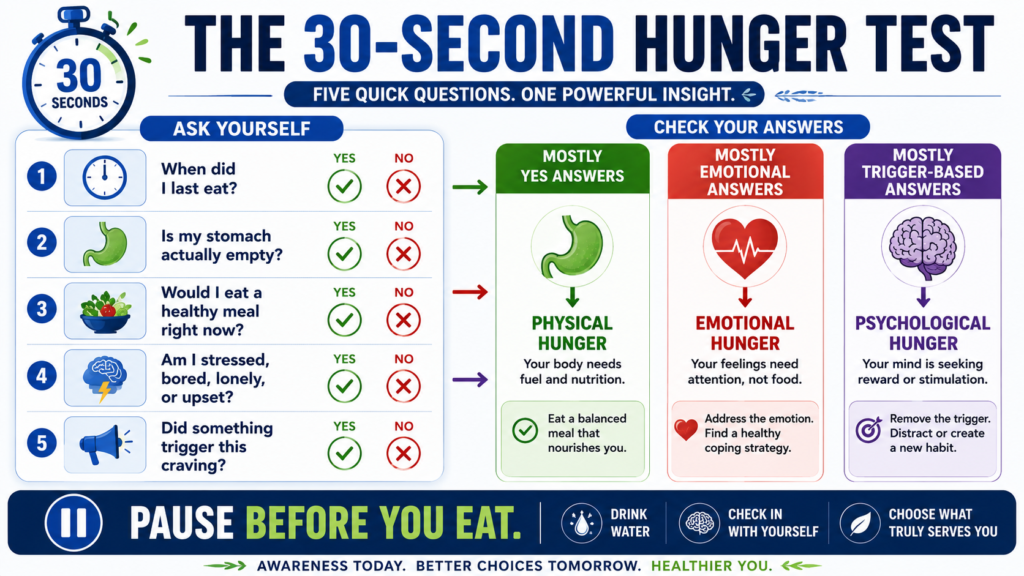
The 30-Second Hunger Test
Before eating, ask yourself these five questions:
Question 1
When did I last eat?
Question 2
Is my stomach actually empty?
Question 3
Would I eat a healthy meal right now?
Question 4
Am I stressed, bored, lonely, or frustrated?
Question 5
Did something trigger this craving?
Scoring
Mostly Physical Answers:
→ Physical hunger
Mostly Emotional Answers:
→ Emotional hunger
Mostly Trigger-Based Answers:
→ Psychological hunger
This simple test can prevent countless episodes of unnecessary eating.
Why This Matters for Weight Loss
Many people trying to lose weight focus only on calories.
But successful weight management often requires understanding hunger itself.
If emotional hunger is driving eating, reducing calories alone won’t solve the problem.
If psychological hunger is driving eating, more willpower won’t solve the problem.
The real solution is identifying the type of hunger first.
How to Respond to Each Type of Hunger
Understanding physical hunger vs emotional hunger vs psychological hunger is only useful if you know what to do next.
Let’s look at practical solutions.
If It’s Physical Hunger
Your body genuinely needs fuel.
The goal is not to ignore hunger.
The goal is to satisfy it intelligently.
Best Strategies
✔ Eat a balanced meal
✔ Include protein
✔ Add fiber-rich foods
✔ Stay hydrated
✔ Avoid skipping meals repeatedly
Examples
- Eggs with vegetables
- Greek yogurt and berries
- Lentils and rice
- Chicken salad
- Oatmeal with nuts
Physical hunger is not the enemy.
Ignoring genuine hunger often leads to stronger cravings later.
If It’s Emotional Hunger
Food cannot solve emotional problems.
It can temporarily distract you, but the emotion usually returns.
Better Alternatives
Instead of eating immediately:
Try:
✔ Take a short walk
✔ Practice deep breathing
✔ Call a friend
✔ Journal your thoughts
✔ Listen to music
✔ Spend time outdoors
Important Question
Ask yourself:
“What am I really feeling right now?”
Many people discover they aren’t hungry.
They’re stressed.
They’re overwhelmed.
They’re lonely.
They’re exhausted.
Recognizing the emotion often reduces the urge to eat.
If It’s Psychological Hunger
Psychological hunger is usually triggered by cues.
The goal is to interrupt the trigger-response cycle.
Practical Solutions
✔ Change your environment
✔ Avoid unnecessary food advertisements
✔ Keep tempting foods out of sight
✔ Create new routines
✔ Delay cravings for 10 minutes
Example
Old Habit:
Watch TV → Eat chips
New Habit:
Watch TV → Drink herbal tea
Over time, the brain begins forming new associations.
Real-Life Scenario #1: The Office Worker
Rahul eats lunch at 1 PM.
At 3 PM he sees coworkers eating donuts.
Suddenly he wants one.
What Type of Hunger Is This?
Most likely:
Psychological hunger.
His stomach isn’t empty.
The visual cue triggered the craving.
Better Response
Wait 15 minutes.
Drink water.
Assess whether actual hunger exists.
Real-Life Scenario #2: The Stressful Day
Sarah has a difficult meeting.
She feels frustrated and anxious.
On the way home she buys ice cream.
What Type of Hunger Is This?
Most likely:
Emotional hunger.
The food is serving as emotional relief.
Better Response
Address the emotion first.
Food should not become the primary coping mechanism.
Real-Life Scenario #3: The Missed Meal
David skips breakfast and lunch.
By 4 PM:
- Stomach growling
- Low energy
- Difficulty concentrating
What Type of Hunger Is This?
Physical hunger.
His body genuinely requires energy.
The correct response is eating a balanced meal.
Why Appetite Control Matters More Than Willpower
Many people think overeating is a willpower problem.
In reality, appetite regulation is influenced by:
- Hunger hormones
- Stress levels
- Sleep quality
- Food environment
- Eating habits
This is why understanding physical hunger vs emotional hunger vs psychological hunger can be more valuable than following another restrictive diet.
When you learn to identify the true cause of hunger, healthy decisions become easier.
Related Articles You May Find Helpful
For deeper understanding of cravings, appetite control, and weight loss psychology:
👉 Why Am I Always Hungry? 7 Hidden Reasons That Make Weight Loss Hard
👉 Why Do I Crave Sugar When I’m Stressed? The Science Behind Stress Eating
👉 Why Does Every Diet Fail After 2 Weeks? The Psychology of Weight Loss Failure
👉 Best Breakfast to Stay Full Longer
👉 How to Boost GLP-1 Naturally Without Medication
These guides build upon the concepts discussed in this article.
When Cravings Keep Winning
Some people struggle with hunger, cravings, and appetite control despite making lifestyle changes.
In these situations, some readers choose to explore evidence-based nutritional support alongside healthy eating habits.
Related Reviews:
👉 GlucoTrustBite Review (2026)
Remember:
No supplement replaces healthy habits.
However, healthy habits become easier when appetite management improves.
Frequently Asked Questions
What is the difference between physical hunger and emotional hunger?
Physical hunger is caused by the body’s need for energy. Emotional hunger is triggered by feelings such as stress, sadness, loneliness, or anxiety.
What is psychological hunger?
Psychological hunger occurs when cravings are triggered by habits, food cues, advertisements, routines, or the brain’s reward system rather than actual nutritional needs.
How do I know if I’m really hungry?
Ask yourself:
Would I eat a balanced meal right now?
If the answer is yes, physical hunger may be present.
If only a specific comfort food sounds appealing, emotional or psychological hunger may be involved.
Why do I crave food when I’m stressed?
Stress increases cortisol levels and can encourage emotional eating behaviors, particularly cravings for sugary and highly processed foods.
Can boredom cause hunger?
Boredom often triggers psychological hunger rather than physical hunger.
The brain seeks stimulation and uses food as entertainment.
Why do I feel hungry after eating?
You may be experiencing emotional hunger, psychological hunger, insufficient protein intake, poor sleep, dehydration, or habit-driven cravings.
Which type of hunger causes weight gain?
Emotional and psychological hunger are more likely to contribute to overeating because food is consumed without genuine physical need.
Can understanding hunger help with weight loss?
Yes.
Recognizing the difference between physical hunger vs emotional hunger vs psychological hunger helps improve appetite control, reduce unnecessary eating, and support long-term weight management.
Key Takeaways
✔ Not all hunger is physical.
✔ Emotional hunger is triggered by feelings.
✔ Psychological hunger is triggered by cues, habits, and rewards.
✔ Physical hunger develops gradually and responds well to food.
✔ Emotional hunger often seeks comfort foods.
✔ Psychological hunger is commonly triggered by food environments.
✔ Understanding physical hunger vs emotional hunger vs psychological hunger can improve appetite awareness and eating decisions.
✔ Identifying the type of hunger before eating is one of the most effective strategies for reducing overeating.
Trusted Sources
For additional evidence-based information:
- Harvard Nutrition Source: https://nutritionsource.hsph.harvard.edu/
- NIDDK – Healthy Eating & Weight Management: https://www.niddk.nih.gov/health-information/weight-management
- American Psychological Association (APA) – Stress: https://www.apa.org/topics/stress
- Centers for Disease Control and Prevention (CDC) Healthy Weight: https://www.cdc.gov/healthy-weight-growth/
Final Thoughts
If you’ve spent years wondering why you keep eating when you’re not truly hungry, the answer may not be a lack of discipline.
The real issue is that many people never learn the difference between physical hunger vs emotional hunger vs psychological hunger.
Physical hunger asks for fuel.
Emotional hunger asks for comfort.
Psychological hunger asks for stimulation or reward.
Once you learn to identify which type of hunger you’re experiencing, eating becomes more intentional, cravings become easier to manage, and long-term weight control becomes far more achievable.
The next time a craving appears, pause for a moment and ask:
“Am I physically hungry, emotionally hungry, or psychologically hungry?”
That single question may completely change your relationship with food.