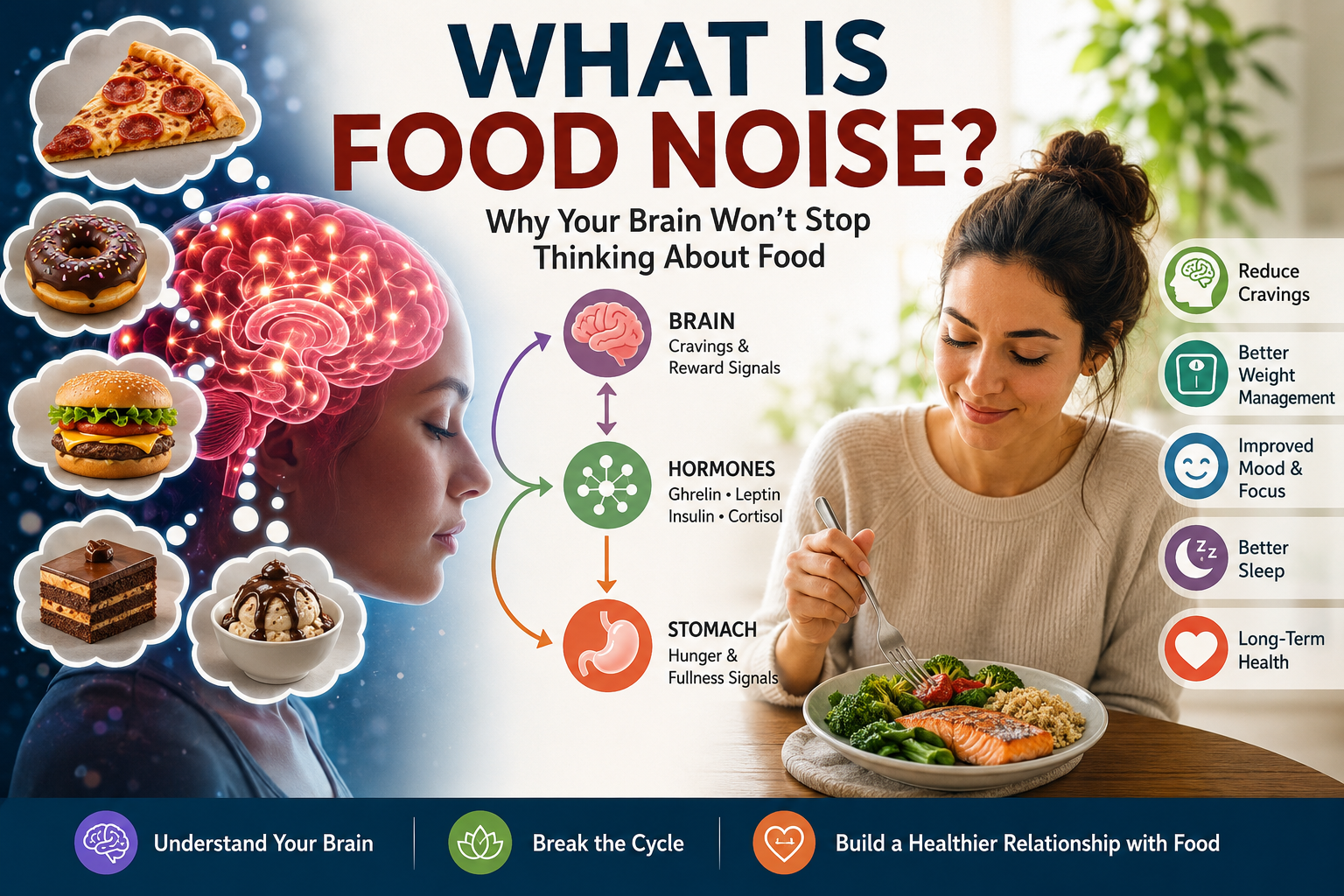
Constantly thinking about What Is Food Noise? Learn what Food Noise is, why it happens, how stress, dopamine, and hunger hormones affect your brain, and science-backed ways to reduce it naturally.
Quick Answer
Do you find yourself thinking about food all day—even after you’ve just eaten? If your mind constantly jumps to your next snack, dessert, or meal, you may be experiencing food noise.
Thank you for reading this post, don't forget to subscribe!Food noise refers to persistent, repetitive thoughts about food that can occur even when your body doesn’t physically need energy. These thoughts are influenced by a combination of brain reward pathways, appetite hormones, stress, sleep, emotions, habits, and today’s highly stimulating food environment. While food noise is not an official medical diagnosis, it has become a widely used term to describe the mental chatter surrounding food that many people experience during weight loss, chronic stress, or metabolic health challenges.
The good news is that food noise is not simply a lack of willpower. Understanding why it happens is the first step toward managing it with evidence-based strategies.
Quick Definition
Food noise is the ongoing mental conversation about food—thinking about what to eat, when to eat, or craving specific foods—even when you are not physically hungry.
Unlike normal hunger, which develops gradually as your body needs energy, food noise often originates in the brain. It is shaped by biological signals (such as dopamine, ghrelin, leptin, and cortisol), psychological factors (including stress and emotional eating), and environmental triggers like food advertisements, social media, or the easy availability of ultra-processed foods.
Many people describe food noise as feeling as though their brain is “constantly reminding them about food,” making it difficult to focus on work, conversations, or everyday activities.
You’re Not Alone: A Real-Life Example
Imagine this:
You finish a balanced lunch with plenty of protein, vegetables, and whole grains. Physically, you feel full.
Twenty minutes later, you’re scrolling through your phone when a video of warm chocolate brownies appears. Suddenly, you’re imagining the taste, wondering whether there’s ice cream in the freezer, and thinking about ordering dessert—even though your stomach isn’t hungry.
Sound familiar?
This is one of the most common examples of food noise.
Your body isn’t necessarily asking for more energy. Instead, your brain is responding to a complex mix of reward signals, habits, emotions, memories, and environmental cues that encourage you to keep thinking about food.
Why This Article Matters
Many people blame themselves for constantly thinking about food.
They often believe:
- “I have no self-control.”
- “I’m addicted to eating.”
- “I must be lazy.”
- “Everyone else can diet except me.”
In reality, modern neuroscience tells a different story.
Your brain has evolved to notice food because, throughout human history, finding enough to eat was essential for survival. Today’s world, however, surrounds us with calorie-dense foods, constant advertising, food delivery apps, and endless social media content about eating. These factors can amplify the brain’s natural reward system, making food thoughts more frequent than they would have been in earlier environments.
Understanding this difference is empowering. Instead of fighting your brain, you can learn how it works—and use practical strategies to reduce unnecessary food noise over time.
What You’ll Learn in This Guide
By the end of this article, you’ll understand:
- What food noise actually means
- Why your brain keeps thinking about food
- The role of dopamine, cortisol, ghrelin, leptin, and other appetite signals
- How stress, sleep, emotions, and modern food environments increase food noise
- The difference between food noise and true physical hunger
- Whether food noise is linked to obesity, diabetes, or GLP-1 medications
- Ten science-backed strategies to quiet food noise naturally
Whether your goal is weight loss, better blood sugar control, improved eating habits, or simply understanding your relationship with food, this guide will help you make sense of what your brain is trying to tell you.
How Does Your Brain Create Food Noise?
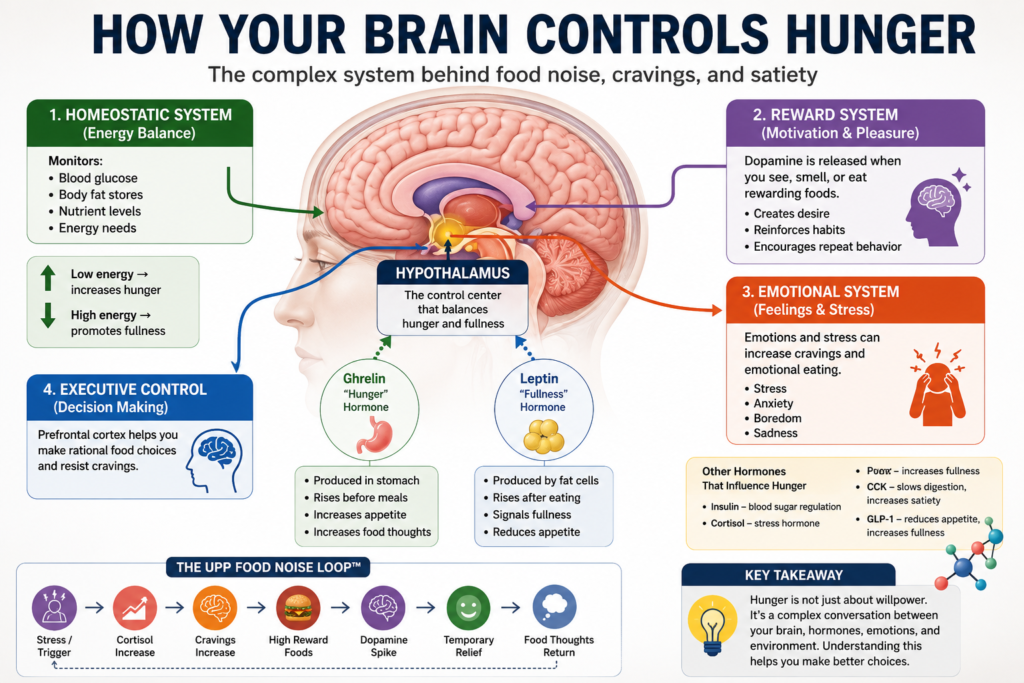
If food noise feels like your brain is constantly reminding you about food, that’s because your brain—not just your stomach—is involved in regulating hunger and appetite.
Eating behavior is controlled by several interconnected systems rather than a single “hunger switch.” These systems continuously communicate with each other using hormones, neurotransmitters, memories, emotions, and environmental cues.
Understanding these systems makes it easier to see why food noise happens—and why it isn’t simply about willpower.
The Brain’s Appetite Control System
Your brain constantly receives information from different parts of your body.
These signals answer questions such as:
- Do you need more energy?
- Have you eaten enough?
- Is there food nearby?
- Are you stressed?
- Are you tired?
- Have you recently experienced pleasure from eating?
Instead of relying on a single signal, your brain combines all this information before influencing your appetite.
The four major systems involved in food noise are:
- Homeostatic (energy regulation)
- Reward system (pleasure and motivation)
- Emotional regulation system
- Executive control system
When these systems work together properly, hunger and fullness remain balanced.
When they become overstimulated or dysregulated, food noise can become much louder.
1. The Homeostatic System: Your Body’s Fuel Gauge
The hypothalamus, a small region deep inside the brain, acts like your body’s energy manager.
Its primary job is to maintain energy balance.
It constantly monitors signals such as:
- Blood glucose
- Body fat stores
- Nutrient availability
- Hormone levels
When energy levels fall, it encourages hunger.
When sufficient energy has been consumed, it promotes fullness.
In an ideal environment, this system would be enough.
However, modern food environments activate another powerful system.
2. The Reward System: Why Your Brain Wants More Than Energy
Imagine eating your favorite dessert.
Even before the first bite, your brain begins releasing dopamine, a neurotransmitter involved in motivation, learning, and reward.
Many people call dopamine the “pleasure chemical.”
That’s only partially correct.
Dopamine doesn’t simply make food enjoyable.
It makes your brain remember:
“This experience is valuable. Let’s repeat it.”
Every enjoyable eating experience strengthens this learning process.
Over time, your brain begins anticipating rewarding foods before you even feel physically hungry.
That’s one reason food advertisements, bakery smells, or social media food videos can immediately trigger thoughts about eating.
Your stomach didn’t ask for food.
Your reward system did.
Dopamine Doesn’t Create Hunger—It Creates Desire
This distinction is extremely important.
Physical hunger says:
“Your body needs energy.”
Dopamine says:
“That pizza looked amazing. Let’s get one.”
Food noise often develops when reward signals become stronger than physical hunger signals.
This is especially common with highly palatable foods rich in sugar, refined carbohydrates, fat, and salt.
These foods stimulate reward pathways much more intensely than minimally processed foods.
3. Ghrelin: The Hunger Hormone
Ghrelin is often called the hunger hormone because it increases before meals and decreases after eating.
It is produced mainly in the stomach and sends messages to the hypothalamus indicating that your body needs food.
Typical effects include:
- Increased appetite
- Greater interest in food
- Stronger food-related thoughts
- Increased motivation to eat
Poor sleep, prolonged dieting, and significant calorie restriction can increase ghrelin levels, making food noise louder.
This explains why people following extremely restrictive diets often think about food much more frequently.
4. Leptin: The Fullness Signal
While ghrelin tells your brain to eat,
Leptin tells your brain that sufficient energy has already been stored.
Leptin is released primarily from fat tissue.
Under normal circumstances, increasing leptin signals reduce appetite.
However, some individuals—particularly those living with obesity—may develop leptin resistance.
In leptin resistance, the brain does not respond efficiently to fullness signals.
As a result:
- Appetite remains elevated.
- Food thoughts may continue.
- Feeling satisfied becomes more difficult.
This is one reason why weight management involves much more than simple willpower.
5. Cortisol: When Stress Turns Up the Volume
Stress doesn’t just affect your mood.
It changes how your brain evaluates food.
During stressful situations, the body releases cortisol, commonly known as the stress hormone.
Persistently elevated cortisol can:
- Increase cravings for calorie-dense foods.
- Strengthen reward-seeking behavior.
- Make emotional eating more likely.
- Increase attention toward sweet and high-fat foods.
This is exactly why many people notice stronger food thoughts during stressful periods.
Related Reading: Why Cortisol Makes You Crave Sugar: How Stress Changes Your Hunger Naturally.
Rather than creating hunger directly, cortisol often amplifies the brain’s reward system, making food appear more attractive.
6. Sleep: The Silent Amplifier
A single night of poor sleep can significantly influence appetite regulation.
Research suggests that inadequate sleep may:
- Increase ghrelin
- Reduce leptin effectiveness
- Increase reward system activity
- Reduce self-control and decision-making
The result?
Food noise often becomes louder the next day.
Many people mistake this for “lack of discipline,” when it is actually a predictable biological response to sleep deprivation.
The UPP Food Noise Loop™
One of the easiest ways to understand food noise is to see it as a repeating cycle rather than a single event.
UPP Food Noise Loop™
Stress
      ↓
Higher Cortisol
      ↓
Stronger Cravings
      ↓
Highly Rewarding Foods
      ↓
Dopamine Activation
      ↓
Temporary Satisfaction
      ↓
Energy Crash & Habit Reinforcement
      ↓
Food Thoughts Return
      ↓
Cycle Repeats
This framework explains why many people feel trapped in an endless cycle of thinking about food.
The solution is not to “fight your brain.”
The goal is to interrupt this cycle by addressing the biological, psychological, and environmental factors that keep it running.
Key Takeaways
Food noise is not controlled by one hormone or one part of the brain.
It develops through the interaction of:
- The hypothalamus regulating energy needs.
- Dopamine reinforcing rewarding eating experiences.
- Ghrelin increasing hunger.
- Leptin signaling fullness.
- Cortisol amplifying cravings during stress.
- Sleep quality influencing all of these systems simultaneously.
When these signals become unbalanced—or when today’s food environment constantly stimulates them—the brain may continue thinking about food even when your body’s energy needs have already been met.
Understanding these mechanisms is the foundation for learning how to reduce food noise effectively.
Related Article
- Why Cortisol Makes You Crave Sugar
- Why Am I Hungry Right After Eating?
- Physical Hunger vs Emotional Hunger vs Psychological Hunger
What Causes Food Noise?
Food noise rarely has a single cause.
Instead, it develops when biology, psychology, lifestyle, and the modern food environment interact with one another. For some people, stress is the biggest trigger. For others, poor sleep, restrictive dieting, emotional distress, blood sugar fluctuations, or constant exposure to tempting foods may be responsible.
Think of food noise as an orchestra. If one instrument becomes louder, you may still hear a balanced melody. But when several instruments play loudly at the same time, the entire experience becomes overwhelming.
Similarly, food noise often becomes noticeable when multiple appetite signals are amplified together.
Let’s examine the most common causes.
1. Chronic Stress: When Survival Mode Changes Your Appetite
Stress is one of the strongest drivers of food noise.
Whenever your brain perceives a stressful situation—whether it’s work pressure, financial concerns, relationship problems, or lack of sleep—it activates the body’s stress response.
One of the major hormones released during this response is cortisol.
Short-term stress may temporarily suppress appetite in some people. However, long-term or chronic stress often has the opposite effect.
Over time, elevated cortisol can:
- Increase cravings for sugary foods
- Increase interest in high-fat foods
- Strengthen reward-seeking behavior
- Make emotional eating more likely
- Keep thoughts about food active for longer periods
Many people notice that they think about snacks more often during stressful weeks, even when they are eating enough calories.
This isn’t a sign of weak willpower.
It’s a predictable biological response designed to encourage energy intake during perceived threats.
Related Reading: Why Cortisol Makes You Crave Sugar: How Stress Changes Your Hunger Naturally.
2. Ultra-Processed Foods Hijack the Brain’s Reward System
Not all foods influence the brain equally.
Whole foods such as vegetables, fruits, legumes, fish, eggs, and nuts provide nutrition while allowing appetite-regulating hormones to function more naturally.
Ultra-processed foods, however, are often engineered to maximize:
- Sweetness
- Saltiness
- Fat content
- Texture
- Aroma
- Convenience
This combination creates what scientists call hyper-palatable foods.
Examples include:
- Potato chips
- Cookies
- Candy
- Ice cream
- Sugary breakfast cereals
- Sweetened beverages
- Fast food
These foods can activate reward pathways much more intensely than minimally processed foods.
The result?
Even after finishing a meal, your brain may continue thinking about eating because it remembers how rewarding these foods felt.
This doesn’t necessarily mean you’re hungry.
It means your reward system has learned to expect another dopamine-rich experience.
3. Blood Sugar Swings Can Increase Food Thoughts
Your brain depends heavily on glucose for energy.
When blood sugar levels rise rapidly after consuming large amounts of refined carbohydrates or sugary drinks, insulin helps move glucose into cells.
A rapid rise is often followed by a rapid fall.
For some individuals, this decline may trigger:
- Increased hunger
- Irritability
- Fatigue
- Difficulty concentrating
- Stronger cravings
- More frequent thoughts about food
People living with diabetes, prediabetes, insulin resistance, or reactive hypoglycemia may notice these changes more frequently.
Maintaining stable blood sugar through balanced meals that include protein, fiber, and healthy fats may help reduce these fluctuations.
4. Emotional Eating Creates Learned Food Associations
Food is more than fuel.
It is closely linked with comfort, celebration, stress relief, and childhood memories.
Over time, the brain begins forming emotional associations such as:
- Feeling sad → Eat chocolate
- Feeling lonely → Order pizza
- Feeling bored → Grab chips
- Feeling anxious → Eat sweets
The more these patterns repeat, the stronger they become.
Eventually, difficult emotions themselves become triggers for food thoughts—even before physical hunger appears.
This is why many people experience food noise during emotionally challenging periods despite eating regular meals.
Related Reading: Physical Hunger vs Emotional Hunger vs Psychological Hunger.
5. Restrictive Dieting Can Make Food Noise Worse
Many people believe that eating less should reduce food thoughts.
Ironically, the opposite often happens.
When calorie restriction becomes too severe, the brain interprets it as a potential threat to survival.
As a result, it responds by:
- Increasing ghrelin
- Increasing food motivation
- Making food appear more rewarding
- Increasing attention toward food cues
- Encouraging larger future meals
This is one reason extremely restrictive diets are difficult to maintain long term.
Food noise isn’t necessarily a sign that the diet “isn’t working.”
It may actually be evidence that your brain is trying to protect your energy balance.
6. Poor Sleep Amplifies Every Appetite Signal
Sleep is one of the most overlooked factors affecting food noise.
Even one night of inadequate sleep may alter:
- Ghrelin
- Leptin
- Cortisol
- Dopamine activity
- Decision-making
After poor sleep, many people notice that:
- Sweet foods seem more appealing.
- Portion sizes increase.
- Snacking becomes more frequent.
- Self-control feels harder.
Instead of blaming yourself after a bad night’s sleep, recognize that your brain is temporarily working under different biological conditions.
7. Habits and Environmental Cues
The brain loves routines.
If you’ve spent years eating popcorn while watching movies, drinking tea with biscuits every afternoon, or ordering takeout every Friday night, your brain begins linking those situations with food.
Eventually, the environment itself becomes the trigger.
Examples include:
- Walking past your favorite bakery
- Seeing a television advertisement
- Smelling fresh pizza
- Opening a food delivery app
- Watching recipe videos on social media
These cues can activate food thoughts long before your body actually needs energy.
8. Hormonal Changes Throughout Life
Hormones naturally fluctuate during different stages of life.
Food noise may become more noticeable during:
- Puberty
- Pregnancy
- Breastfeeding
- Perimenopause
- Menopause
- Certain menstrual cycle phases
Hormonal shifts can influence appetite regulation, cravings, and mood, making food thoughts more frequent for some individuals.
9. Certain Medical Conditions and Medications
Persistent food noise may sometimes be associated with underlying health conditions.
Examples include:
- Obesity
- Type 2 diabetes
- Insulin resistance
- Polycystic ovary syndrome (PCOS)
- Depression
- Anxiety disorders
- ADHD
- Binge Eating Disorder
Some medications may also affect appetite.
Examples include:
- Corticosteroids
- Certain antidepressants
- Some antipsychotic medications
- Certain diabetes medications
- GLP-1 receptor agonists (which often reduce food noise rather than increase it)
If food noise develops suddenly after starting a new medication, or is accompanied by rapid weight changes or significant distress, discussing it with a healthcare professional is appropriate.
10. Today’s Food Environment Keeps Your Brain Thinking About Food
Thousands of years ago, food was relatively difficult to obtain.
Today, food is available almost everywhere.
Your brain is constantly exposed to:
- Television commercials
- Social media recipes
- Food influencers
- Delivery app notifications
- Supermarket displays
- Restaurant promotions
- Celebrations centered around eating
These repeated exposures activate attention and reward systems even when your body has sufficient energy.
Modern environments make food noise much more common than it was in previous generations.
UPP Trigger Wheel™
One way to understand food noise is to identify which trigger is affecting you the most.
Biological Triggers
- Hunger hormones
- Blood sugar fluctuations
- Sleep deprivation
- Hormonal changes
Psychological Triggers
- Stress
- Anxiety
- Boredom
- Loneliness
- Emotional eating
Environmental Triggers
- Food advertisements
- Social media
- Smells
- Habits
- Easy food availability
Most people experience a combination of triggers, not just one.
Recognizing your dominant trigger is the first step toward reducing food noise.
Key Takeaways
Food noise is not caused by a lack of discipline.
Instead, it often results from several overlapping influences, including:
- Chronic stress
- Reward-seeking brain pathways
- Blood sugar fluctuations
- Emotional eating patterns
- Restrictive dieting
- Poor sleep
- Hormonal changes
- Habit loops
- Modern food environments
Understanding which triggers apply to you is far more helpful than blaming yourself for thinking about food.
In the next section, we’ll answer one of the most common questions:
How can you tell the difference between food noise and real physical hunger?
That distinction is often the turning point in learning to eat more mindfully and confidently.
Food Noise vs Real Hunger: How to Tell the Difference
One of the biggest reasons people struggle with eating habits is that they confuse food noise with physical hunger.
Although both make you think about food, they come from different systems inside your body and brain.
Understanding the difference is one of the most powerful skills you can develop for long-term weight management and a healthier relationship with food.
Physical Hunger vs Food Noise
| Physical Hunger | Food Noise |
|---|---|
| Starts gradually | Can appear suddenly |
| Caused by the body’s energy needs | Caused mainly by brain signals, emotions, habits, or environmental cues |
| Any balanced meal sounds satisfying | Usually specific foods sound appealing |
| Continues until you eat | May continue even after eating |
| Often accompanied by stomach sensations | Usually begins as thoughts, cravings, or mental images |
| Improves after a nutritious meal | May return shortly after eating |
| Supports survival | Often seeks pleasure, comfort, or reward |
Example 1
You skipped breakfast.
By noon:
- Your stomach growls.
- Your energy feels low.
- Almost any healthy meal sounds good.
This is physical hunger.
Example 2
You finish dinner.
Ten minutes later, someone opens a box of donuts.
Suddenly you’re thinking,
“Maybe just one…”
Even though you’re physically full.
This is much more likely to be food noise.
The 5-Question Food Noise Check
Whenever you’re unsure whether you’re actually hungry, ask yourself these five questions.
1. Would I eat a simple balanced meal right now?
If the answer is yes, physical hunger is more likely.
If the answer is:
“No… but I’d definitely eat chocolate.”
Food noise may be driving the urge.
2. Did the urge appear suddenly?
Physical hunger usually develops slowly.
Food noise often appears instantly after:
- Seeing food
- Smelling food
- Watching food videos
- Feeling stressed
- Feeling bored
3. Did I eat within the last 2–3 hours?
If you recently finished a balanced meal but your mind immediately wants dessert or snacks, the feeling may not represent true energy needs.
4. What emotion am I feeling?
Pause for a moment.
Are you feeling:
- Stressed?
- Lonely?
- Anxious?
- Angry?
- Bored?
- Tired?
Sometimes the brain asks for food when it is actually asking for relief.
5. If this food disappeared, would I still feel hungry?
Imagine your favorite snack suddenly wasn’t available.
Would you happily eat something simple like yogurt, fruit, eggs, or vegetables?
If yes, you’re probably hungry.
If not, your brain may simply be chasing a specific reward.
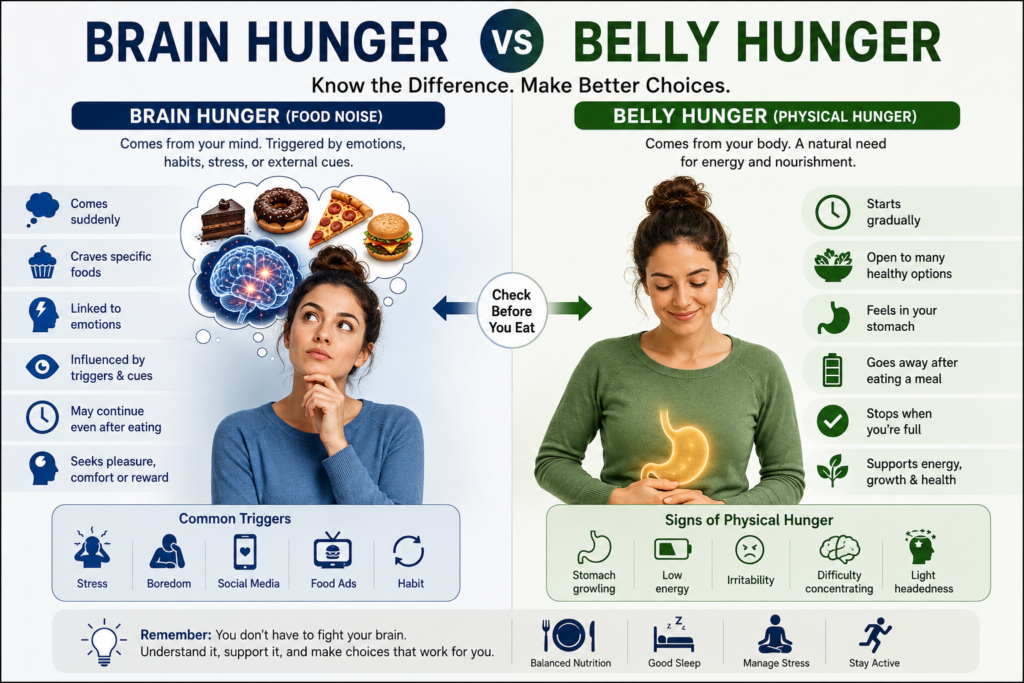
The UPP Brain vs Belly Test™
One of the easiest ways to identify food noise is by asking:
Where is this hunger coming from?
Belly Hunger (Physical)
Usually includes:
- Empty stomach
- Stomach growling
- Low energy
- Mild weakness
- Hunger develops gradually
Body says:
“I need fuel.”
Brain Hunger (Food Noise)
Usually includes:
- Thinking about one specific food
- Sudden cravings
- Eating because others are eating
- Wanting dessert after feeling full
- Food advertisements triggering cravings
- Emotional discomfort
Brain says:
“I want reward.”
Can You Experience Both at the Same Time?
Yes.
Many people experience mixed hunger.
For example:
You skip lunch.
By evening you’re genuinely hungry.
Then you order pizza.
Instead of stopping after two slices, stress and food reward pathways encourage you to continue eating.
Here,
Physical Hunger
Food Noise
are working together.
Recognizing both signals helps you make more balanced decisions rather than blaming yourself.
Is Food Noise a Medical Condition?
This is one of the most common questions people ask.
The short answer is:
No—not by itself.
Food noise is not currently recognized as an official medical diagnosis in major diagnostic manuals.
Instead, it is a descriptive term used to explain persistent thoughts about food.
However, food noise can become more noticeable in people living with certain medical or psychological conditions.
Conditions Associated With Increased Food Noise
Food noise may be more common in individuals with:
- Obesity
- Type 2 Diabetes
- Prediabetes
- Insulin Resistance
- Polycystic Ovary Syndrome (PCOS)
- Chronic Stress
- Anxiety Disorders
- Depression
- Attention-Deficit/Hyperactivity Disorder (ADHD)
- Binge Eating Disorder (BED)
Having one of these conditions does not automatically mean you will experience food noise, but the risk may be higher because appetite regulation, reward pathways, or emotional processing can be affected.
When Should You Seek Professional Help?
Occasional food thoughts are completely normal.
However, consider speaking with a qualified healthcare professional if:
- Food thoughts interfere with work, study, or relationships.
- You feel out of control around food regularly.
- You experience frequent binge eating episodes.
- You rapidly gain or lose weight without explanation.
- Food anxiety causes significant emotional distress.
- You suspect an eating disorder.
Early support often leads to better long-term outcomes.
Can GLP-1 Medications Reduce Food Noise?
Recently, many people have reported that medications such as semaglutide and tirzepatide significantly reduce food noise.
Although research is still evolving, this observation has attracted considerable scientific interest.
These medications were originally developed to improve blood sugar regulation and support weight management.
However, many patients also describe:
- Fewer intrusive thoughts about food.
- Reduced cravings.
- Feeling satisfied with smaller meals.
- Less interest in constant snacking.
- Improved control over eating behaviors.
Scientists believe this may occur because GLP-1 receptor agonists influence appetite-regulating areas of the brain, slow stomach emptying, and enhance feelings of fullness.
It’s important to remember that GLP-1 medications are prescription medicines and are not appropriate for everyone. They should only be used under the guidance of a qualified healthcare professional.
Related Reading: Ozempic vs Wegovy vs Mounjaro (2026): Which GLP-1 Drug Works Best for Weight Loss?
Can Food Noise Be Reduced Without Medication?
Absolutely.
While some people benefit from prescription treatments, many individuals can reduce food noise by improving lifestyle habits that influence appetite regulation.
Evidence suggests that the following factors may help:
- Eating enough protein and fiber.
- Sleeping 7–9 hours regularly.
- Managing chronic stress.
- Building consistent meal routines.
- Limiting exposure to highly processed foods.
- Becoming aware of emotional eating triggers.
- Staying physically active.
- Practicing mindful eating.
These approaches work by supporting the same biological systems involved in appetite regulation rather than simply relying on willpower.
The next section explores these strategies in detail with 10 science-backed methods to quiet food noise naturally.
Key Takeaways
Food noise and physical hunger are not the same thing.
Physical hunger helps your body survive.
Food noise reflects the interaction of brain reward pathways, hormones, emotions, habits, and environmental influences.
Learning to distinguish between Brain Hunger and Belly Hunger is often the first major step toward building healthier eating habits.
Whether food noise is driven by stress, poor sleep, blood sugar changes, or modern food environments, understanding why it happens allows you to choose strategies that address the underlying cause instead of simply fighting the symptoms.
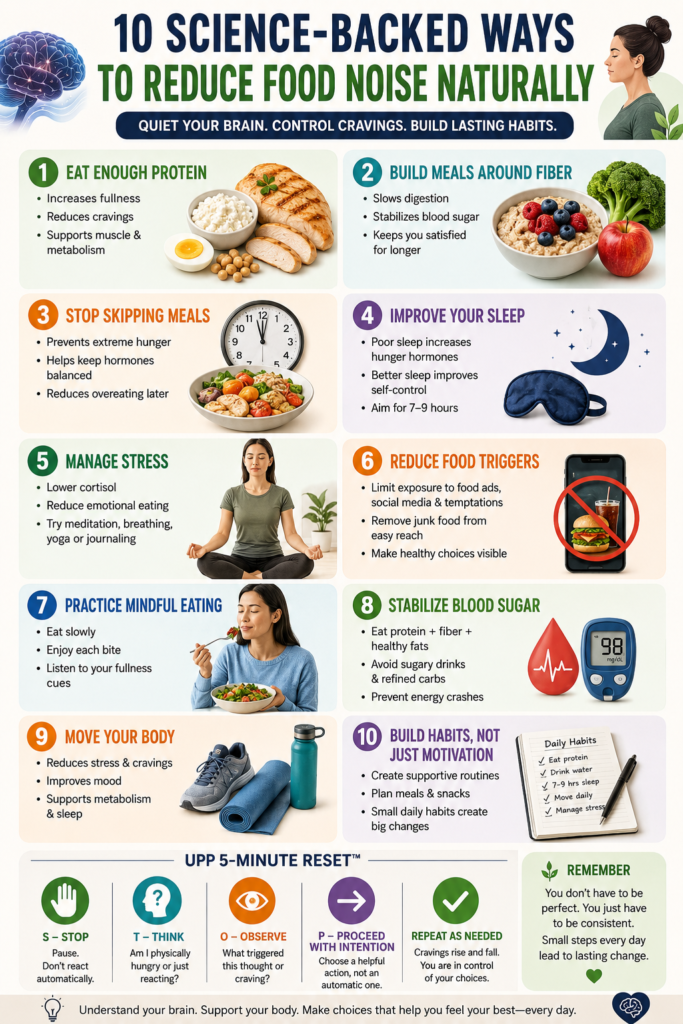
10 Science-Backed Ways to Reduce Food Noise Naturally
Food noise cannot usually be eliminated overnight.
Instead of trying to “silence” your brain through willpower alone, the goal is to create an environment where your appetite-regulating systems work together more effectively.
The strategies below are supported by research on nutrition, sleep, stress management, appetite regulation, and behavioral psychology.
1. Eat Enough Protein at Every Meal
Protein is one of the most satisfying nutrients you can eat.
Compared with meals low in protein, higher-protein meals generally help:
- Increase feelings of fullness
- Reduce hunger between meals
- Support muscle mass during weight loss
- Slow digestion
- Reduce unnecessary snacking
Good protein sources include:
- Eggs
- Fish
- Chicken
- Greek yogurt
- Cottage cheese
- Lentils
- Beans
- Tofu
- Soy products
Instead of asking,
“How can I eat less?”
Try asking,
“How can I make this meal more satisfying?”
2. Build Meals Around Fiber
Fiber works together with protein to keep you satisfied longer.
High-fiber foods slow digestion and help create a steady release of energy.
Examples include:
- Vegetables
- Fruits
- Whole grains
- Oats
- Beans
- Lentils
- Chia seeds
- Flaxseeds
A meal containing both protein and fiber is generally more effective at reducing food noise than a meal made mostly of refined carbohydrates.
3. Stop Skipping Meals
Many people skip breakfast or lunch hoping to lose weight.
Unfortunately, prolonged gaps between meals can increase:
- Ghrelin
- Cravings
- Portion sizes
- Food preoccupation
When the brain senses prolonged energy restriction, it naturally begins focusing more on food.
For many people, eating regular, balanced meals is more effective than cycling between fasting and overeating.
4. Improve Your Sleep Before Blaming Your Willpower
Poor sleep changes appetite regulation almost immediately.
Research suggests that inadequate sleep may:
- Increase ghrelin
- Reduce leptin signaling
- Increase cortisol
- Strengthen reward-seeking behavior
If food noise becomes much worse after a poor night’s sleep, your biology—not your motivation—is likely playing a significant role.
Aim for 7–9 hours of consistent sleep whenever possible.
Simple habits such as reducing screen time before bed, keeping a regular sleep schedule, and limiting caffeine late in the day may improve sleep quality.
5. Learn to Manage Stress Instead of Feeding It
Stress is one of the strongest amplifiers of food noise.
When stress remains uncontrolled, cortisol can increase cravings for calorie-dense foods.
Instead of automatically reaching for snacks, experiment with alternative stress-management techniques:
- Deep breathing
- Short walks
- Stretching
- Meditation
- Journaling
- Talking with someone you trust
- Listening to calming music
Reducing stress does not remove every craving, but it often lowers the overall “volume” of food noise.
6. Reduce Your Exposure to Food Triggers
Your brain responds to what it sees repeatedly.
Constant exposure to food-related content may increase food thoughts even when you are not hungry.
Consider reducing unnecessary triggers such as:
- Food delivery app notifications
- Endless cooking videos
- Junk food stored within easy reach
- Constant television food advertisements
Instead, make healthier choices more visible.
For example:
- Keep fruit on the kitchen counter.
- Store vegetables at eye level in the refrigerator.
- Place less nutritious snacks out of immediate sight.
Small environmental changes often make healthier decisions easier.
7. Practice Mindful Eating
Mindful eating means paying attention to your food without distractions.
Instead of eating while scrolling through your phone or watching television, try to notice:
- Taste
- Texture
- Smell
- Hunger level
- Fullness level
Eating slowly allows your brain more time to recognize satiety signals.
Many people discover that they feel satisfied with less food simply because they become more aware of what they are eating.
8. Stabilize Blood Sugar Throughout the Day
Large swings in blood sugar can increase hunger and cravings.
To help maintain more stable energy levels:
- Include protein with every meal.
- Add healthy fats in moderation.
- Choose high-fiber carbohydrates more often.
- Limit sugary drinks.
- Avoid relying on sweets for quick energy.
Balanced meals are generally more effective than simply reducing calories.
9. Move Your Body Regularly
Exercise is often viewed only as a way to burn calories.
However, regular physical activity also influences:
- Stress
- Mood
- Insulin sensitivity
- Sleep quality
- Appetite regulation
Even moderate activities such as walking for 20–30 minutes most days of the week may help improve overall metabolic health and reduce stress-related food thoughts.
The goal is consistency—not perfection.
10. Build Habits Instead of Relying on Motivation
Motivation changes from day to day.
Habits last much longer.
Examples of supportive habits include:
- Eating breakfast at a consistent time.
- Planning meals ahead.
- Drinking water before meals.
- Grocery shopping with a list.
- Keeping nutritious snacks available.
- Going to bed at a regular time.
Every small habit reduces the number of decisions your brain has to make, making food noise less likely to take control.
The UPP 5-Minute Reset™
When food noise suddenly becomes intense, don’t panic.
Instead, use the UPP 5-Minute Reset™.
S — Stop
Pause before reacting.
Don’t immediately open the refrigerator or order food.
Take one slow breath.
T — Think
Ask yourself:
“Am I physically hungry, or am I reacting to stress, boredom, or habit?”
Use the Brain vs Belly Test™ from the previous section.
O — Observe
Notice what triggered the food thought.
Was it:
- A stressful email?
- A food advertisement?
- Poor sleep?
- Loneliness?
- A specific emotion?
Identifying the trigger helps interrupt the automatic habit loop.
P — Proceed With Intention
Choose your next step consciously.
If you’re physically hungry:
✅ Eat a balanced meal.
If you’re experiencing food noise:
Consider another response first:
- Drink water.
- Take a 5-minute walk.
- Stretch.
- Practice breathing exercises.
- Call a friend.
- Wait 10 minutes before deciding.
Often, the intensity of food noise decreases once the immediate trigger passes.
A Realistic Perspective
It’s important to understand that food noise is unlikely to disappear completely.
Even people with excellent eating habits occasionally experience cravings or think about food.
The goal is not perfection.
The goal is reducing the frequency, intensity, and influence of food noise so that it no longer controls your decisions.
Small improvements repeated consistently often produce better long-term results than trying to follow a perfect diet for a few weeks.
Soft Evidence-Based Support
Some people with persistent food noise—especially those living with obesity, diabetes, or significant metabolic health challenges—may benefit from additional support beyond lifestyle changes.
This could include:
- Working with a registered dietitian.
- Behavioral counseling.
- Structured weight-management programs.
- Evidence-based prescription medications when clinically appropriate.
While certain supplements are marketed for appetite control, no over-the-counter supplement has been proven to eliminate food noise on its own. Lifestyle changes remain the foundation of long-term success, and any supplement should be considered only as a complementary strategy after discussing it with a qualified healthcare professional.
Key Takeaways
Reducing food noise is not about having stronger willpower.
It is about creating conditions where your brain receives clearer signals of nourishment, safety, and satisfaction.
The most effective long-term strategies include:
- Prioritizing protein and fiber
- Sleeping well
- Managing stress
- Stabilizing blood sugar
- Building consistent habits
- Reducing environmental triggers
- Practicing mindful eating
Rather than fighting your brain, work with it.
Understanding how food noise develops—and responding with evidence-based habits instead of self-criticism—can help you build a healthier and more sustainable relationship with food.
Food Noise: Myths vs Facts
Food noise has become a popular term online, but there are still many misconceptions. Understanding what science actually says can help you make better decisions about your health.
| Myth | Fact |
|---|---|
| Food noise means you have no willpower. | Food noise is influenced by brain reward pathways, hormones, emotions, sleep, stress, and environmental cues—not just willpower. |
| Thinking about food means you’re always hungry. | Food thoughts can occur without physical hunger, especially when triggered by stress, habits, or highly palatable foods. |
| Only people with obesity experience food noise. | Anyone can experience food noise, although it may be more common in certain metabolic or psychological conditions. |
| Skipping meals helps reduce cravings. | For many people, prolonged calorie restriction can actually increase food thoughts and cravings. |
| One supplement can stop food noise completely. | There is currently no supplement proven to eliminate food noise on its own. Sustainable improvements usually involve nutrition, sleep, stress management, physical activity, and—in some cases—medical treatment. |
Expert Clinical Tips
If you’re experiencing frequent food noise, remember these practical principles:
✔ Don’t confuse cravings with hunger.
✔ Eat balanced meals that include protein, fiber, and healthy fats.
✔ Avoid labeling foods as “good” or “bad,” which can increase psychological restriction.
✔ Prioritize sleep and stress management as seriously as nutrition.
✔ Notice your triggers before reacting automatically.
✔ Seek professional help if food thoughts are causing significant distress or affecting your quality of life.
The goal isn’t to never think about food. The goal is to prevent food thoughts from controlling your decisions.
Frequently Asked Questions (FAQ)
What is food noise?
Food noise refers to persistent thoughts about food, eating, or cravings that continue even when your body may not physically need energy. It is influenced by biological, psychological, and environmental factors.
Is food noise normal?
Occasional food thoughts are completely normal. However, persistent food noise that causes distress or interferes with daily life may indicate that appetite regulation, stress, sleep, habits, or underlying health conditions should be evaluated.
Why can’t I stop thinking about food?
Common reasons include:
Chronic stress
Poor sleep
Blood sugar fluctuations
Emotional eating
Restrictive dieting
Highly processed foods
Habit loops
Modern food environments
Usually, several factors work together rather than a single cause.
Can anxiety or stress cause food noise?
Yes.
Stress activates cortisol and can increase cravings for calorie-dense foods. Anxiety may also increase repetitive thoughts about food, especially when eating has become a coping strategy.
Is food noise the same as emotional eating?
No.
Food noise refers to persistent thoughts about food.
Emotional eating is the behavior of eating in response to emotions.
Food noise can contribute to emotional eating, but they are not identical.
Can GLP-1 medications reduce food noise?
Many patients report reduced food thoughts while taking GLP-1 receptor agonists such as semaglutide or tirzepatide. Research suggests these medications influence appetite-regulating pathways in the brain, but they should only be used under medical supervision.
Can food noise be reduced naturally?
Yes.
Many people experience improvements by:
Eating enough protein and fiber
Sleeping well
Managing stress
Staying physically active
Reducing exposure to food cues
Building consistent eating habits
Does food noise mean I have an eating disorder?
Not necessarily.
Food noise itself is not an official diagnosis. However, persistent food thoughts combined with binge eating, severe restriction, or emotional distress should be discussed with a qualified healthcare professional.
What foods may help reduce food noise?
No single food eliminates food noise.
However, balanced meals rich in:
Protein
Fiber
Whole grains
Vegetables
Healthy fats
are generally more satisfying than highly processed foods.
Should I see a doctor about food noise?
Consider seeking professional advice if:
Food thoughts interfere with daily life.
You experience binge eating episodes.
You have rapid unexplained weight changes.
You suspect diabetes, thyroid disease, PCOS, or another medical condition affecting appetite.
Trusted References
PubMed (Medical Research Database)
Dietary Guidelines for Americans
Centers for Disease Control and Prevention (CDC) Nutrition
Conclusion
Food noise is more than simply “thinking about food.”
It reflects the interaction between your brain, hormones, emotions, habits, sleep, stress, and the modern food environment.
The most important lesson is this:
Food noise is not a personal failure.
Your brain is constantly trying to balance survival, reward, and energy needs. In today’s world—where highly processed foods, social media, and constant food cues surround us—those signals can become amplified.
The encouraging news is that food noise can often be reduced by understanding its causes and making sustainable lifestyle changes. Prioritizing balanced nutrition, regular sleep, stress management, physical activity, and mindful eating can help create a healthier relationship with food over time.
Progress doesn’t require perfection. Every small step toward understanding your body’s signals is a step toward long-term metabolic health.
Medical Disclaimer
This article is intended for educational purposes only and should not be considered medical advice. Food noise may sometimes be associated with underlying medical or psychological conditions. If you experience persistent food thoughts, significant distress, binge eating, unexplained weight changes, or concerns about your physical or mental health, consult a qualified healthcare professional for personalized evaluation and treatment.