
Author: Drx. Prashant Kumar
Thank you for reading this post, don't forget to subscribe!Category: Metabolic Health & Weight Loss
Updated: 2026
Quick Answer
If you’ve ever asked yourself, “why does every diet fail after 2 weeks?”, you’re not alone. Most diets fail because motivation fades, hunger hormones increase, old habits return, and the brain begins resisting restriction. The problem is often not a lack of willpower—it’s human psychology.
Many people successfully follow a diet during the first week. However, by the second week, cravings increase, enthusiasm decreases, and consistency becomes harder. Understanding why this happens can help you build a sustainable approach to weight loss.
Why Does Every Diet Fail After 2 Weeks?
Millions of people start a new diet every year.
The first few days usually feel exciting.
You clean out your pantry.
You buy healthy foods.
You feel motivated.
The scale even starts moving in the right direction.
Then something strange happens.
Around day 10 to day 14, motivation drops.
Cravings become stronger.
The diet feels harder.
You begin thinking about foods you weren’t even craving before.
Eventually, many people abandon the plan and start over again a few weeks later.
This cycle is so common that many people constantly wonder:
Why does every diet fail after 2 weeks?
The answer lies in biology, psychology, and behavior—not weakness.
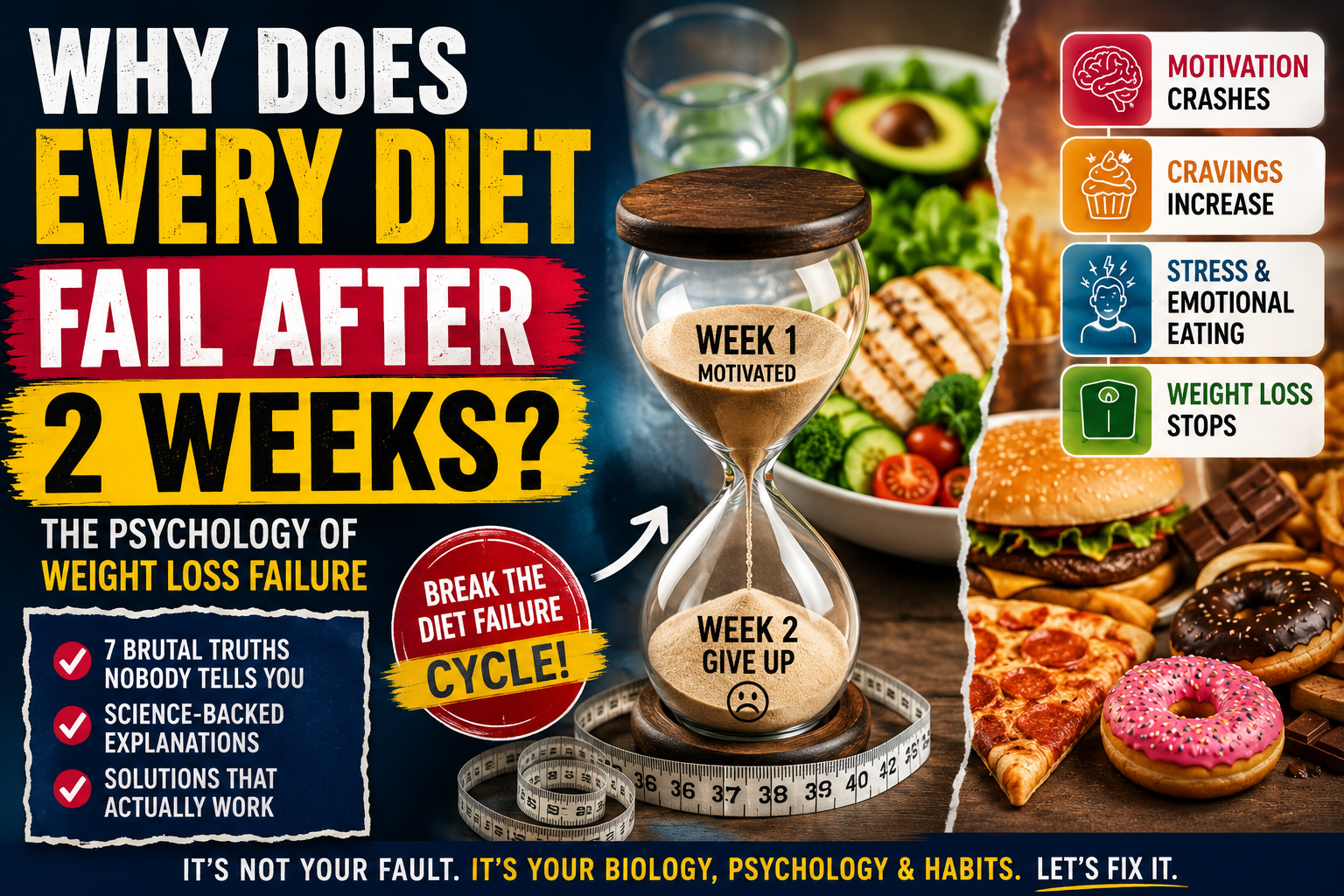
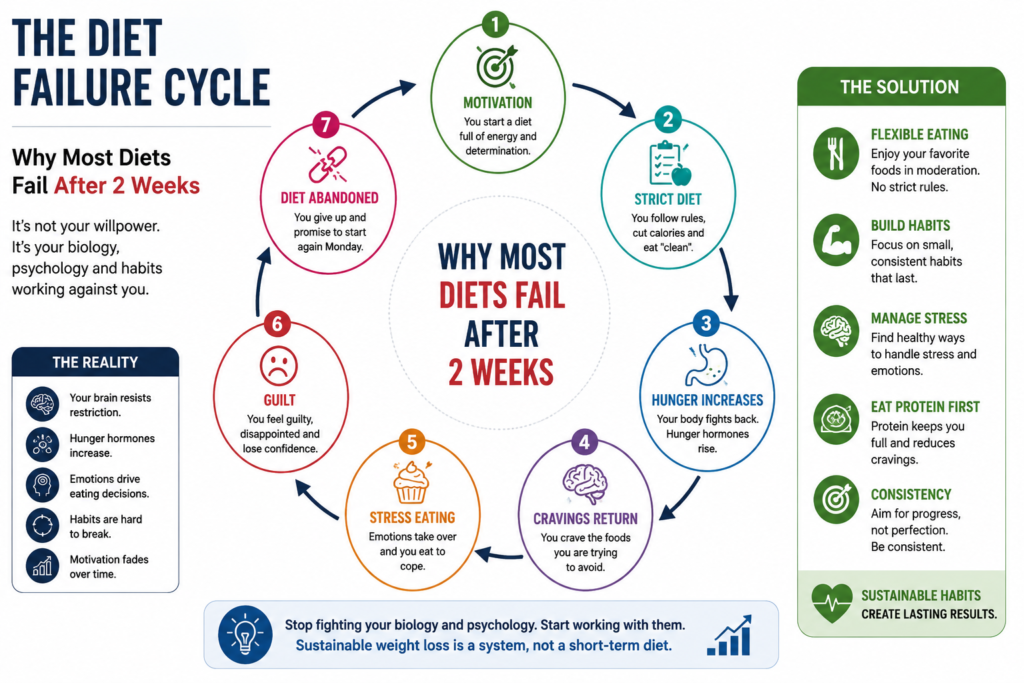
The Weight Loss Cycle Most People Experience
Week 1:
- High motivation
- Excitement
- Rapid initial weight loss
- Strong commitment
Week 2:
- Cravings increase
- Hunger rises
- Motivation declines
- Stress eating returns
Week 3:
- Cheat meals become frequent
- Consistency disappears
- Weight loss slows
Week 4:
- Diet abandoned
This pattern happens so often that researchers have studied it extensively.
The reality is that your brain and body are designed to resist sudden change.
The Science Behind Diet Failure
Before discussing the seven brutal truths, it’s important to understand something:
Your brain values survival more than weight loss.
When calories drop significantly, your body doesn’t celebrate.
Instead, it interprets the situation as a potential threat.
This triggers biological responses that increase hunger and reduce adherence.
This is one reason why many people repeatedly ask:
Why does every diet fail after 2 weeks even when I’m motivated?
The answer often involves hormones, reward systems, habits, and psychology working together.
Brutal Truth #1: Motivation Is Temporary
Most diets begin with motivation.
The problem?
Motivation is emotional.
And emotions fluctuate.
During the first week, enthusiasm is high because you’re imagining future results.
You picture:
- Weight loss
- Better health
- More confidence
- Smaller clothing sizes
These expectations create excitement.
However, motivation naturally decreases over time.
The people who succeed long-term are not necessarily more motivated.
They simply rely less on motivation and more on systems.
Real-Life Example
John starts a strict diet on Monday.
For ten days he follows every rule.
By day twelve, work stress increases.
Motivation fades.
Old eating habits return.
The diet collapses.
The issue wasn’t knowledge.
The issue was relying entirely on motivation.
Brutal Truth #2: Your Brain Hates Restriction
One of the biggest answers to the question:
“Why does every diet fail after 2 weeks?”
is psychological restriction.
When you tell yourself:
“I can never eat pizza again.”
“I can never eat dessert again.”
Your brain often reacts by wanting those foods even more.
Psychologists sometimes refer to this as the “forbidden food effect.”
The more restricted a food becomes, the more powerful it appears.
This explains why people who avoid sweets completely often spend the entire day thinking about sweets.
Practical Solution
Instead of:
❌ Never eat chocolate.
Try:
✅ Eat chocolate occasionally within a structured plan.
Flexibility is usually more sustainable than perfection.
Brutal Truth #3: Hunger Hormones Start Fighting Back
Weight loss is not only a mental challenge.
It is also a hormonal challenge.
When calorie intake decreases:
- Ghrelin (hunger hormone) may increase.
- Fullness signals may weaken.
- Appetite often rises.
This is why dieting can feel easy initially but become much harder later.
Many people assume they suddenly became lazy.
In reality, their biology is pushing them to eat more.
Example
After two weeks of aggressive dieting:
- Hunger feels stronger.
- Food becomes more rewarding.
- Cravings increase.
The brain is attempting to restore energy balance.
This biological response is a major reason why many diets fail after two weeks.
Brutal Truth #4: Dopamine Stops Working the Way You Expect
When most people start a diet, they feel excited.
Why?
Because they expect quick results.
The scale drops.
Friends notice.
Clothes fit better.
This creates a dopamine boost.
Dopamine is often called the brain’s reward chemical.
However, something important happens after a couple of weeks.
The brain adapts.
The excitement that existed during week one begins to fade.
The same healthy meals no longer feel exciting.
The same weight-loss routine feels repetitive.
Many people interpret this as failure.
In reality, it’s simply neurological adaptation.
Real-Life Example
Week 1:
- Every healthy meal feels like progress.
- Every pound lost feels exciting.
Week 3:
- Results feel slower.
- Excitement decreases.
- Diet feels boring.
This is one of the most overlooked answers to the question:
Why does every diet fail after 2 weeks?
People often quit because the emotional reward disappears before the physical transformation arrives.
Practical Solution
Stop relying only on scale victories.
Track:
- Energy levels
- Better sleep
- Reduced cravings
- Improved fitness
- Waist measurements
These create alternative sources of motivation.
Brutal Truth #5: Emotional Eating Returns Under Stress
Many diets work perfectly until life becomes difficult.
Then:
- Work stress increases
- Family problems arise
- Sleep quality drops
Suddenly the diet collapses.
Why?
Because food was never the real problem.
Stress was.
Many people use food to regulate emotions without realizing it.
Food can temporarily provide:
- Comfort
- Relief
- Distraction
- Pleasure
This explains why a stressful day often leads to overeating.
The Hidden Problem
A diet may successfully change food choices.
But it may never address emotional coping mechanisms.
When stress returns, old behaviors return.
Ask Yourself
When you overeat:
Are you physically hungry?
Or emotionally overwhelmed?
The answer often reveals the real trigger.
Brutal Truth #6: All-or-Nothing Thinking Destroys Diets
One of the most damaging psychological patterns in weight loss is:
All-or-Nothing Thinking
Example:
Breakfast:
✔ Healthy
Lunch:
✔ Healthy
Dinner:
✔ Healthy
Then:
🍕 One slice of pizza
Immediately the brain says:
“I ruined everything.”
Then comes:
- Dessert
- Late-night snacks
- Entire cheat weekend
This mindset destroys more diets than food itself.
Reality
One unhealthy meal does not ruin progress.
Just like one healthy meal does not create progress.
Consistency matters more than perfection.
Better Mindset
Instead of:
❌ I failed.
Use:
✅ I made one imperfect choice and I’m moving forward.
This simple mental shift dramatically improves long-term success.
Brutal Truth #7: Your Habits Are Stronger Than Your Goals
Most people focus on goals.
Very few focus on habits.
The brain loves automation.
Consider this example:
Every night:
- Watch TV
- Eat snacks
After repeating this behavior hundreds of times, it becomes automatic.
Then a diet attempts to remove the behavior overnight.
The brain resists.
Not because you’re weak.
Because habits are deeply wired.
Real-Life Scenario
Sarah wants to lose weight.
Every evening she eats chips while watching Netflix.
The problem isn’t chips.
The problem is the habit loop.
Cue:
TV
Routine:
Eating chips
Reward:
Comfort
Unless the habit loop changes, the diet usually fails.
Practical Solution
Replace rather than remove.
Example:
Old Habit:
TV → Chips
New Habit:
TV → Herbal Tea + Greek Yogurt
This approach works with the brain instead of against it.
Why Does Every Diet Fail After 2 Weeks for Most People?
By now, the pattern should be clear.
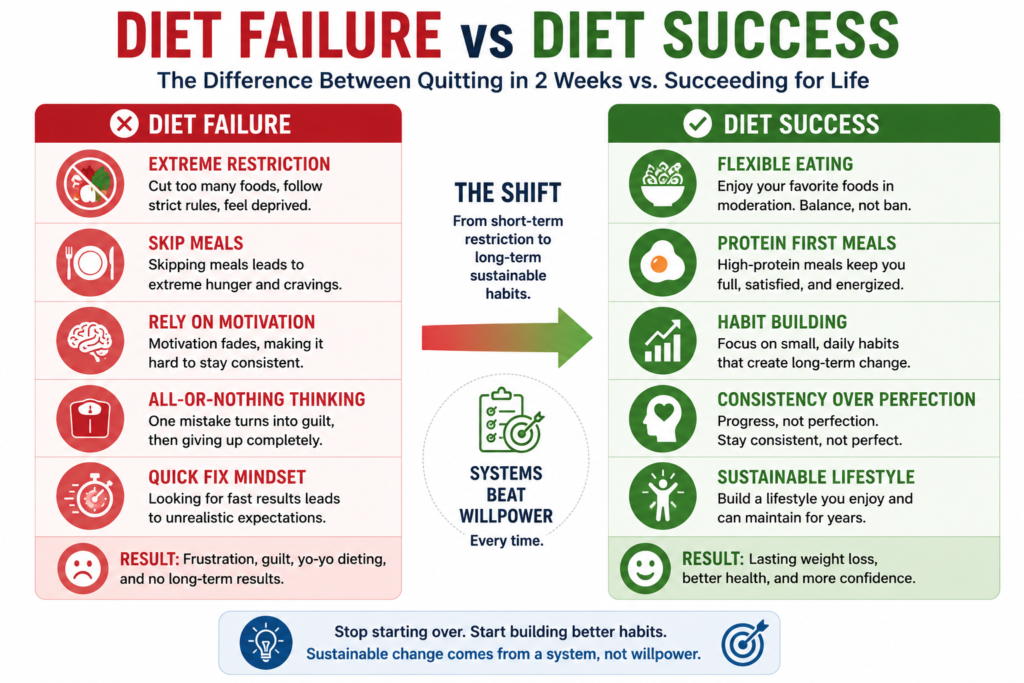
Most diets fail because:
✔ Motivation fades
✔ Restriction increases cravings
✔ Hunger hormones increase
✔ Dopamine adapts
✔ Stress triggers emotional eating
✔ All-or-nothing thinking takes over
✔ Old habits return
None of these problems are solved through willpower alone.
That’s why many intelligent, motivated people repeatedly struggle with dieting.
The issue is usually psychology—not knowledge.
Real-Life Case Study: The Typical Diet Failure Cycle
Meet David.
Age: 38
Goal: Lose 30 pounds.
Week 1:
- Removes sugar
- Starts exercising
- Loses 4 pounds
Week 2:
- Work stress increases
- Sleep decreases
- Hunger increases
Week 3:
- Eats fast food once
Thought:
“I ruined my diet.”
Week 4:
- Completely quits
Three months later:
Starts another diet.
This cycle repeats.
The problem wasn’t effort.
The problem was the system.
David was trying to fight biology and psychology with motivation alone.
The Sustainable Alternative
Instead of asking:
“How can I lose weight fast?”
Ask:
“How can I create habits I can follow for years?”
This question changes everything.
Successful weight loss usually comes from:
- Small changes
- Consistent habits
- Flexible eating
- Better stress management
- Realistic expectations
People who win long-term rarely rely on extreme diets.
They build sustainable systems.
The Diet Success Framework: What Actually Works Long-Term?
If most diets fail after two weeks, what should you do instead?
The answer isn’t another restrictive meal plan.
The answer is building a system that works with human psychology.
Step 1: Focus on Consistency, Not Perfection
Many people believe successful weight loss requires perfect eating.
It doesn’t.
A person who follows a healthy eating plan 80% of the time will usually outperform someone who follows a strict diet for 10 days and then quits.
Better Goal
Instead of:
❌ Never eat dessert.
Try:
✅ Eat nutritious meals most of the time.
This mindset reduces guilt and improves long-term adherence.
Step 2: Build Protein-First Meals
Protein is one of the most powerful nutrients for appetite control.
Higher-protein meals may help:
- Increase fullness
- Reduce cravings
- Support muscle maintenance
- Improve diet adherence
Examples
- Eggs and vegetables
- Greek yogurt with berries
- Chicken salad
- Cottage cheese and fruit
- Lentil-based meals
This is one reason our readers often benefit from:
👉 Best Breakfast to Stay Full Longer
👉 Best GLP-1 Diet Plan for Beginners
Step 3: Manage Hunger Before It Manages You
Extreme hunger destroys consistency.
Many people accidentally create:
- Huge calorie deficits
- Meal skipping
- Long fasting periods
Then wonder:
Why does every diet fail after 2 weeks?
The answer is often simple:
They became too hungry to sustain the plan.
Better Strategy
Focus on:
✔ Protein
✔ Fiber
✔ Water
✔ Structured meals
✔ Reasonable calorie deficits
Step 4: Prepare for Stress Before It Happens
Stress is predictable.
Life will never be stress-free.
Instead of hoping stress disappears, create a plan for stressful days.
Example
When stressed:
Instead of:
❌ Fast food
❌ Sugar binge
Try:
✅ Walk for 10 minutes
✅ Call a friend
✅ Protein snack
✅ Herbal tea
This approach reduces emotional eating triggers.
Step 5: Make Healthy Choices Easier
Environment often beats willpower.
If cookies are sitting on the kitchen counter every day, cravings become harder to manage.
Simple Environment Changes
- Keep healthy snacks visible
- Store treats out of sight
- Meal prep ahead of time
- Avoid grocery shopping when hungry
Small changes often create surprisingly large results.
When Appetite Control Becomes the Biggest Challenge
Many readers discover that their biggest obstacle isn’t motivation.
It’s appetite.
If hunger, cravings, and overeating repeatedly derail your progress, improving appetite control may be more important than following another restrictive diet.
Some readers choose to explore evidence-based nutritional support alongside healthy habits.
Related Reviews:
👉 GlucoTrustBite Review (2026): Does It Really Control Blood Sugar & Cravings?
👉 Gluco6 Review (2026): Can It Really Stop Cravings & Balance Blood Sugar?
👉 LeanBiome Review 2026 — Gut Bacteria Weight Loss Formula Explained
Remember:
No supplement can replace healthy habits.
But healthy habits become easier when appetite and cravings are better managed.
Frequently Asked Questions
Why does every diet fail after 2 weeks?
Most diets fail because motivation decreases, hunger increases, old habits return, and restrictive rules become difficult to maintain.
Is it normal to lose motivation after starting a diet?
Yes. Motivation naturally fluctuates. Sustainable weight loss relies more on habits and systems than temporary motivation.
Why do cravings increase after two weeks?
Cravings may increase because of calorie restriction, hunger hormones, emotional triggers, stress, and psychological restriction.
Can stress cause a diet to fail?
Yes. Stress can increase emotional eating, sugar cravings, and impulsive food choices, making diet adherence more difficult.
What is all-or-nothing thinking in weight loss?
It is the belief that one imperfect meal ruins all progress. This mindset often leads to overeating and diet abandonment.
Are strict diets effective long-term?
Research generally shows that highly restrictive diets are difficult to maintain and often result in poor long-term adherence.
How can I stop quitting diets?
Focus on sustainable habits, flexible eating, realistic goals, and consistency rather than perfection.
What is the best way to stay full while dieting?
Meals rich in protein, fiber, and minimally processed foods often improve satiety and help reduce cravings.
Key Takeaways
✔ If you’re asking “why does every diet fail after 2 weeks”, you’re facing a challenge shared by millions of people.
✔ Most diet failures are caused by psychology and biology—not laziness.
✔ Motivation naturally fades.
✔ Restriction often increases cravings.
✔ Hunger hormones become stronger during calorie restriction.
✔ Stress and emotional eating frequently derail progress.
✔ Habits are more powerful than short-term motivation.
✔ Sustainable systems outperform extreme diets.
Trusted Resources
For additional evidence-based information:
- Harvard Nutrition Source
- CDC Healthy Weight Resources
- National Institute of Diabetes and Digestive and Kidney Diseases (NIDDK)
- American Psychological Association Stress Resources
Final Thoughts
If you’ve repeatedly wondered,
“Why does every diet fail after 2 weeks?”
the answer is probably not a lack of discipline.
Most people fail because they’re trying to fight powerful biological and psychological forces using motivation alone.
The good news is that lasting weight loss doesn’t require perfection.
It requires understanding how your brain works.
When you learn to manage hunger, cravings, habits, stress, and expectations, weight loss becomes far more sustainable.
Instead of searching for the perfect diet, focus on building a lifestyle you can realistically maintain for years.
That is where real transformation happens.

[…] ➡️ Why Does Every Diet Fail After 2 Weeks? 7 Brutal Truths About Weight Loss Psychology […]